Data Science / Analytics
Data is one of the most valuable assets for modern businesses, but only when it is accurate, organized, and easy to use. Many companies collect data from ERP systems, CRMs, websites, mobile apps, IoT devices, and cloud platforms. Unfortunately, this information often sits in separate systems, making it difficult to generate reliable reports or business insights.
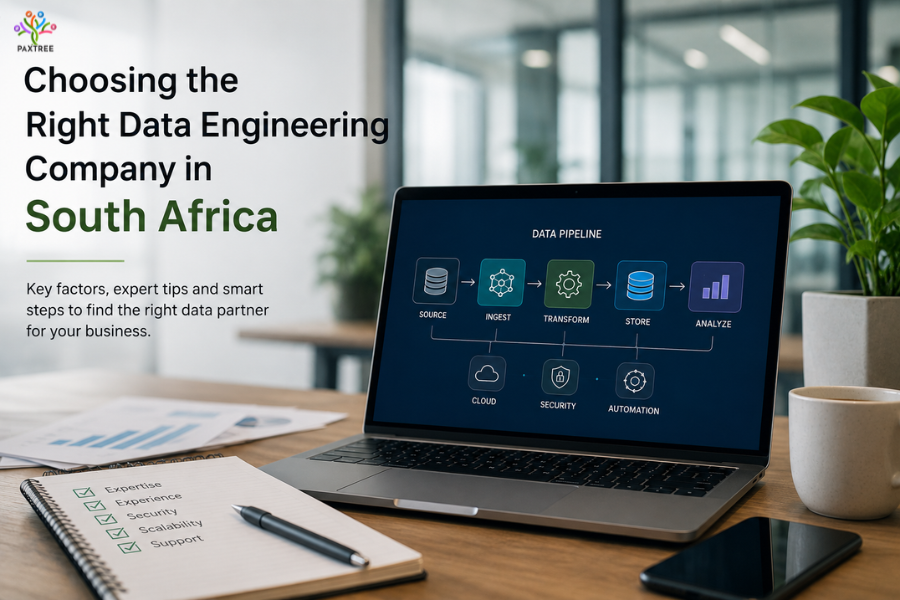
That is why businesses across South Africa are investing in professional data engineering services. A skilled data engineering company in South Africa can build scalable data pipelines, automate ETL processes, integrate multiple data sources, and prepare your business for analytics, artificial intelligence (AI), and business intelligence (BI).
However, not every service provider delivers the same level of expertise. Choosing the wrong partner can lead to project delays, poor data quality, security issues, unexpected costs, and systems that fail to support future growth.
This guide explains exactly how to evaluate a data engineering company, the questions to ask before hiring, and the factors that matter most when selecting a long-term technology partner.
Quick Answer
Choosing the right data engineering company in South Africa starts with evaluating business experience, technical expertise, cloud capabilities, security standards, communication, and long-term support. Rather than selecting the lowest-priced vendor, businesses should look for a partner with proven experience in ETL automation, data integration, cloud platforms, and scalable architecture. The right company should understand your business goals, deliver reliable data solutions, and provide ongoing support that helps your organization grow with confidence.
Why Choosing the Right Data Engineering Partner Matters
Many businesses focus only on software or reporting tools without realizing that every successful analytics project begins with reliable data.
If your data is incomplete, duplicated, or spread across different systems, even the most advanced dashboards will produce inaccurate insights.
Choosing the right data engineering partner directly impacts your business by helping you:
Improve Decision-Making
Executives rely on accurate reports to make strategic decisions. Poor-quality data often leads to incorrect forecasts, budgeting mistakes, and missed business opportunities.
A professional data engineering team builds reliable data pipelines that ensure decision-makers always work with trustworthy information.
Reduce Manual Work
Many organizations still spend hours exporting spreadsheets, copying data between systems, and manually preparing reports.
Automating these processes through ETL pipelines allows employees to focus on higher-value work instead of repetitive tasks.
Support AI and Advanced Analytics
Artificial intelligence depends on clean, structured, and well-organized data.
Without a strong data engineering foundation, AI projects often fail because the underlying data is inconsistent or incomplete.
Improve Customer Experience
Businesses that integrate customer information from multiple systems gain a complete view of customer behavior.
This enables better personalization, faster support, and improved customer satisfaction.
Scale as Your Business Grows
Your business may have thousands of records today but millions tomorrow.
An experienced data engineering company builds scalable infrastructure that grows alongside your business without requiring expensive redesigns.
When Does Your Business Need a Data Engineering Company?
Many organizations don’t realize they need data engineering until operational problems begin affecting productivity and business performance.
If you recognize any of the following situations, it may be time to work with a professional data engineering company in South Africa.
Your Reports Take Too Long to Create
If employees spend hours collecting information from different systems before creating reports, your reporting process is costing valuable time and money.
Automated data pipelines can generate reports in minutes instead of hours.
Your Data Is Stored in Multiple Systems
Your customer information may exist in:
- CRM software
- ERP systems
- Accounting software
- E-commerce platforms
- Marketing tools
- Cloud applications
Without proper integration, each department works with different information.
Data engineering connects these systems into a single, reliable source of truth.
Your Business Is Migrating to the Cloud
Cloud migration involves much more than moving databases.
Businesses need secure migration planning, optimized data architecture, and scalable cloud infrastructure.
Experienced data engineers ensure the migration happens with minimal disruption.
You’re planning AI or machine learning projects.
AI solutions require clean, organized, and continuously updated datasets.
Before implementing AI, businesses should first establish strong data engineering processes.
This reduces project risk and improves AI accuracy.
Your Dashboards Show Different Numbers
One of the biggest warning signs is when different departments generate different reports using the same business data.
This usually indicates poor data governance and disconnected systems.
Professional data engineering eliminates these inconsistencies.
Your Business Is Growing Rapidly
As organizations grow, data volumes increase significantly.
Systems that worked for a small business often struggle as customer numbers, transactions, and operational data expand.
Scalable data architecture prevents future performance issues.
Build an In-House Team or Hire a Data Engineering Company?
One of the biggest decisions businesses face is whether to build an internal data engineering team or partner with a specialized data engineering company in South Africa.
Both options have advantages, but the right choice depends on your budget, timeline, technical requirements, and long-term business goals.
Option 1: Build an In-house Data Engineering Team
Hiring full-time engineers gives you complete control over your projects and internal processes.
However, building an experienced team requires significant investment.
Typical costs include the following:
- Recruitment expenses
- Salaries and employee benefits
- Training and certifications
- Software licenses
- Cloud infrastructure
- Hardware and development tools
- Employee retention costs
Finding experienced data engineers can also take several months, delaying critical business initiatives.
Best For
- Large enterprises
- Businesses with continuous long-term data engineering requirements
- Organizations with substantial technology budgets
Option 2: Hire a Data Engineering Company
Working with an experienced partner provides immediate access to specialists without the lengthy hiring process.
Instead of recruiting multiple professionals, you gain a complete team with expertise in data architecture, ETL automation, cloud platforms, data integration, and project management.
This approach reduces implementation time while giving your business access to proven processes and best practices.
Best For
- Startups
- SMEs
- Growing businesses
- Companies undergoing digital transformation
- Organizations migrating to cloud platforms
- Businesses implementing AI or Business Intelligence solutions
Comparison: Build vs Hire
| Factor | Build In-house Team | Hire a Data Engineering Company |
| Initial Investment | High | Lower upfront cost |
| Recruitment Time | Several months | Immediate project start |
| Access to Expertise | Depends on hiring | Team of experienced specialists |
| Technology Knowledge | Limited to employees | Multi-platform expertise |
| Scalability | Slower | Easily scalable |
| Project Risk | Higher during hiring | Lower due to proven experience |
| Ongoing Support | Internal responsibility | Included by most service providers |
| Time to Business Value | Longer | Faster implementation |
Which Option Is Right for You?
If your business requires a permanent, dedicated engineering department with ongoing internal development, building an in-house team may be the right investment.
However, if your goal is to launch projects faster, reduce hiring costs, access experienced specialists, and minimize project risk, partnering with an experienced data engineering company in South Africa is often the more practical and cost-effective choice.
The right technology partner brings not only technical expertise but also industry knowledge, proven delivery processes, and the flexibility to scale your data infrastructure as your business grows.
Freelancer vs Agency vs In-house Team: Which Is the Better Choice?
When planning a data engineering project, many businesses compare three options-hiring freelancers, building an in-house team, or partnering with a data engineering agency. While all three approaches can work, the best choice depends on your project scope, budget, timeline, and long-term business goals.
Let’s compare them across the factors that matter most.
| Factor | Freelancer | Data Engineering Agency | In-house Team |
| Initial Cost | Low | Medium | High |
| Technical Expertise | Depends on one individual | Access to a multidisciplinary team | It depends on hired employees |
| Scalability | Limited | Easy to scale resources | Slow hiring process |
| Project Management | Self-managed | Dedicated project management | Managed internally |
| Availability | May vary | Reliable team availability | Full-time employees |
| Security & Compliance | Limited | Established security practices | Controlled internally |
| Delivery Speed | Suitable for small projects | Faster for medium and large projects | Slower due to hiring and onboarding |
| Long-term Support | Not always available | Ongoing support and maintenance | Internal responsibility |
When Should You Hire a Freelancer?
A freelancer may be suitable if you
- Need a small ETL script or data migration task.
- Have a limited budget.
- Require short-term technical assistance.
- Already have an internal technical team managing the project.
For larger projects involving cloud platforms, multiple integrations, or enterprise data pipelines, relying on one person can increase delivery and support risks.
When Does an Agency Make More Sense?
A professional data engineering company in South Africa offers much more than technical development. You gain access to solution architects, ETL specialists, cloud engineers, quality assurance professionals, and project managers working together to deliver reliable outcomes.
This is often the preferred choice for businesses that need the following:
- Cloud migration
- Enterprise data warehouses
- Business Intelligence implementation
- AI-ready data platforms
- Ongoing support and maintenance
- Long-term technology partnerships
When Should You Build an In-House Team?
Building an internal team is a good option if your business continuously develops and maintains complex data infrastructure and has the budget to recruit, train, and retain experienced professionals.
For many startups and growing businesses, outsourcing to a trusted agency provides faster implementation and better access to specialized expertise.
10 Things to Evaluate Before Hiring a Data Engineering Company
Choosing a vendor should never be based solely on price. A slightly lower project cost today can lead to significantly higher expenses later if the solution is poorly designed or difficult to maintain.
Here are the ten most important factors to evaluate before making your decision.
1. Industry Experience
Every industry has different data challenges.
For example:
- Healthcare requires strict compliance and security.
- Retail businesses focus on customer analytics.
- Manufacturing depends on IoT and operational data.
- Financial services require high accuracy and governance.
Choose a company that understands your industry’s unique requirements.
2. Technical Expertise
Ask which technologies the company works with regularly.
Look for experience in:
- ETL and ELT
- Data Warehousing
- Data Lakes
- Apache Spark
- Azure Data Factory
- AWS Data Pipeline
- Google Cloud Platform
- Snowflake
- Databricks
- Microsoft Fabric
A broader technology stack usually indicates greater flexibility when designing the right solution.
3. Cloud Platform Experience
Many organizations are moving their data infrastructure to the cloud.
Ensure the company has practical experience with platforms such as:
- Amazon Web Services (AWS)
- Microsoft Azure
- Google Cloud Platform (GCP)
Cloud expertise is essential for scalability, security, and long-term performance.
4. Data Security and Compliance
Your business data is one of your most valuable assets.
Ask how the company handles:
- Data encryption
- Access control
- Backup strategies
- Disaster recovery
- Compliance requirements
- Secure cloud architecture
A professional partner should prioritize security throughout the project lifecycle.
5. Solution Scalability
Your current requirements may be modest, but your business will continue to grow.
Ask whether the proposed architecture can support:
- More users
- Higher transaction volumes
- Additional applications
- Future AI initiatives
- Business expansion
Building for scalability today prevents costly redesigns later.
6. Communication and Project Management
Successful projects depend on clear communication.
Ask questions such as:
- Who will manage the project?
- How often will progress be shared?
- Which collaboration tools are used?
- How are project risks handled?
Transparent communication helps projects stay on schedule and within budget.
7. Documentation Quality
Comprehensive documentation makes future maintenance easier.
Your vendor should provide documentation covering:
- System architecture
- Data pipelines
- Integration processes
- Database design
- Deployment procedures
- User guides where applicable
Good documentation reduces dependency on a single developer or team.
8. Support and Maintenance
Launching the project is only the beginning.
Ask about:
- Response times
- Service Level Agreements (SLAs)
- Bug fixes
- Performance monitoring
- System upgrades
- Ongoing optimization
Reliable post-launch support is essential for long-term success.
9. Client References and Case Studies
A reputable company should be able to demonstrate previous work.
Request:
- Case studies
- Client testimonials
- References
- Industry experience
- Measurable project outcomes
Real-world success stories provide confidence that the company can deliver similar results for your business.
10. Transparent Pricing
The cheapest proposal is not always the most cost-effective.
Look for pricing that clearly explains:
- Project scope
- Deliverables
- Timelines
- Support
- Additional charges
- Payment milestones
Transparent pricing helps avoid misunderstandings and unexpected expenses.
Data Engineering Vendor Evaluation Checklist
Before signing a contract, use this checklist to compare different vendors.
Technical Expertise
- Experience with ETL and ELT
- Cloud platform expertise (AWS, Azure, or GCP)
- Data Warehouse implementation
- Data integration experience
- AI and Business Intelligence readiness
Business Experience
- Experience in your industry
- Relevant client case studies
- Positive client references
- Proven project delivery process
Project Delivery
- Dedicated project manager
- Clear communication process
- Regular progress updates
- Comprehensive documentation
Security
- Secure development practices
- Data governance expertise
- Backup and disaster recovery planning
- Compliance knowledge
Long-term Support
- Post-launch maintenance
- Performance optimization
- Ongoing technical support
- Clearly defined SLA
If multiple vendors meet these requirements, compare their communication style, business understanding, and long-term partnership approach-not just their pricing.
Hidden Costs Businesses Often Overlook
Many organizations budget only for development without considering additional costs that arise during implementation.
Understanding these expenses in advance helps avoid budget overruns and project delays.
Data Migration
Migrating data from legacy systems often requires cleaning, validation, transformation, and testing.
Poor-quality data can significantly increase migration effort.
Third-party Integrations
Connecting CRM systems, ERP software, finance applications, marketing platforms, and APIs may require additional development beyond the initial scope.
Cloud Infrastructure
Hosting costs vary depending on:
- Storage
- Compute resources
- Data transfer
- Backup services
- Monitoring tools
These operational expenses should be included in long-term planning.
Software Licensing
Some data engineering solutions require commercial licenses for analytics platforms, databases, or integration tools.
Clarify licensing requirements before the project begins.
Training and Change Management
Employees may require training to understand new reporting tools, dashboards, or workflows.
Planning for onboarding improves user adoption and maximizes project value.
Ongoing Maintenance
Every modern data platform requires continuous maintenance, including:
- Security updates
- Performance tuning
- Bug fixes
- Infrastructure optimization
- Platform upgrades
Choosing a vendor that offers proactive support can reduce long-term operational costs.
Scope Changes
Business requirements often evolve during implementation.
Discuss the vendor’s process for managing change requests and additional work before signing the agreement.
Clear expectations reduce delays and help keep projects on budget.
What ROI Can You Expect from Hiring a Data Engineering Company?
Investing in data engineering is not just about organizing data-it’s about improving the way your business operates. A well-designed data platform helps teams make faster decisions, reduce manual work, and uncover opportunities that would otherwise remain hidden.
The return on investment (ROI) comes from increased efficiency, better data quality, and improved business performance over time.
Here are some of the key benefits businesses typically experience.
Faster Reporting
Many organizations spend hours-or even days-collecting data from different systems before creating reports.
Automated ETL pipelines eliminate repetitive manual work by continuously collecting, transforming, and loading data into a central repository.
Instead of waiting for reports, decision-makers gain access to near-real-time insights.
Better Decision-Making
Reliable decisions depend on reliable data.
When every department works from the same trusted data source, leadership teams can confidently forecast revenue, monitor performance, identify trends, and respond quickly to changing business conditions.
Reduced Operational Costs
Manual processes consume valuable employee time.
Automating data collection, integration, and reporting reduces repetitive tasks, minimizes human errors, and allows employees to focus on higher-value activities.
Over time, these efficiencies can significantly reduce operational expenses.
Improved Customer Experience
Bringing together customer data from sales, marketing, support, and operations creates a complete customer view.
This enables businesses to:
- Deliver personalized experiences
- Respond to customer issues faster
- Improve retention
- Identify new sales opportunities
AI and Analytics Readiness
Artificial intelligence, machine learning, and advanced analytics depend on accurate, well-structured data.
A strong data engineering foundation ensures your business is prepared to adopt AI technologies without rebuilding its data infrastructure later.
Scalable Growth
As your business grows, so does the volume of data.
A scalable data platform allows you to add new applications, users, data sources, and analytics capabilities without redesigning the entire system.
This protects your investment and supports long-term business growth.
Red Flags to Watch Before Signing a Contract
Not every vendor has the experience needed to deliver a successful data engineering project.
Before selecting a partner, watch for these common warning signs.
No Relevant Experience
If a company cannot demonstrate previous work or explain how it has solved similar business challenges, consider it a risk.
Ask for case studies, references, or examples of completed projects.
Unrealistically Low Pricing
Choosing the cheapest proposal may seem attractive, but very low pricing often results in:
- Limited project scope
- Poor documentation
- Inexperienced developers
- Additional charges later
- Lack of long-term support
Focus on overall value rather than the lowest quote.
Generic Proposals
Every business has unique requirements.
If a proposal looks generic and doesn’t address your specific goals, systems, or challenges, the vendor may not fully understand your project.
A reliable partner should recommend a tailored solution.
No Clear Communication Process
Communication problems often become project problems.
Ask:
- Who will be your primary contact?
- How often will progress meetings take place?
- How are issues escalated?
- What project management tools are used?
Clear communication builds trust and keeps projects moving smoothly.
Lack of Security Focus
Data security should never be treated as an afterthought.
Your vendor should explain how they protect the following:
- Sensitive business data
- Customer information
- Cloud infrastructure
- User access
- Backup and disaster recovery
If security isn’t discussed during the proposal stage, it’s worth asking additional questions.
No Post-Launch Support
A data platform requires ongoing monitoring, updates, and optimization.
Avoid vendors that disappear once the project is delivered.
Choose a partner that offers continuous maintenance and technical support.
Why Businesses Choose Paxtree
Choosing a technology partner is about more than technical expertise. Businesses need a team that understands their goals, communicates clearly, and delivers solutions that continue to provide value long after implementation.
At Paxtree, we help businesses across South Africa design and build modern data platforms that support reporting, analytics, cloud migration, and digital transformation initiatives.
Our approach focuses on understanding your business first and recommending solutions that align with your operational needs and future growth plans.
Here’s what businesses value when working with Paxtree:
- Experienced data engineering professionals
- Expertise in ETL automation and data integration
- Cloud-ready architectures using AWS, Azure, and Google Cloud
- Scalable solutions designed for future business growth
- Transparent communication throughout every project phase
- Secure and reliable data engineering practices
- Ongoing maintenance and technical support after deployment
Whether you’re modernizing legacy systems, building a centralized data warehouse, or preparing for AI adoption, our team works closely with you to deliver practical, scalable, and reliable solutions.
Final Thoughts
Choosing the right data engineering company in South Africa is a strategic decision that can influence your business for years to come. The right partner will do more than build data pipelines-they will help you create a reliable data foundation that supports better decisions, improves operational efficiency, and enables future innovation.
Before making your final decision, compare vendors based on their experience, technical capabilities, communication, security practices, and long-term support rather than focusing only on cost. Taking the time to evaluate these factors can help you avoid expensive mistakes and ensure your investment delivers lasting value.
Ready to Build a Smarter Data Infrastructure?
If you’re looking for a trusted data engineering company in South Africa, Paxtree can help.
Our team specializes in data engineering services, ETL automation, cloud data engineering, data integration, and modern data platforms that help businesses turn complex data into meaningful business insights.
Whether you’re planning a cloud migration, building a data warehouse, automating reporting, or preparing for AI initiatives, we’ll work with you to design a solution that fits your business goals.
Contact Paxtree today for a free consultation and discover how the right data engineering strategy can help your business scale with confidence.