AI/ML
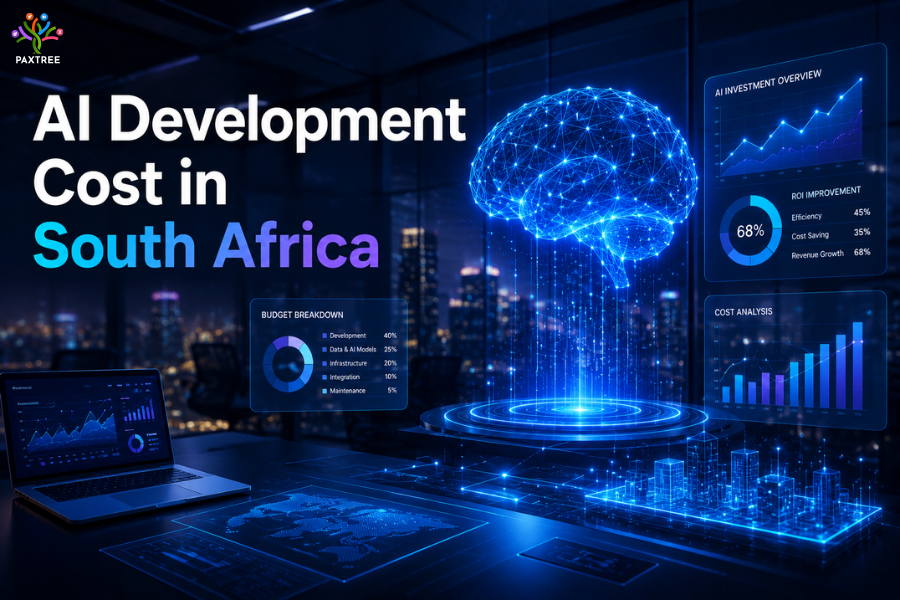
The AI development cost in South Africa typically ranges from R180,000 to over R5,000,000, depending on project complexity, AI models, integrations, data availability, infrastructure, and business requirements. Small AI automation projects cost significantly less than enterprise AI platforms, while custom AI applications require greater investment but often deliver substantial long-term returns through automation, improved decision-making, and operational efficiency.
AI Is No Longer a Future Investment. It’s a competitive advantage.
A few years ago, artificial intelligence was mainly associated with global technology companies and research laboratories. Today, it has become a practical business tool used by organizations of every size.
From banks using fraud detection to retailers providing personalized shopping experiences, AI is helping businesses reduce costs, improve customer experiences, and make faster decisions.
South African businesses are following the same trend.
Companies across healthcare, finance, manufacturing, logistics, retail, agriculture, education, and professional services are investing in AI to automate repetitive work, improve productivity, and gain a competitive advantage.
However, one question appears in almost every executive meeting before an AI project begins.
How much does AI development actually cost?
The answer isn’t as straightforward as purchasing traditional software.
Unlike ready-made applications, AI solutions are designed around specific business challenges. Every organization has different objectives, data quality, workflows, integrations, and security requirements. As a result, development costs vary considerably from one project to another.
Understanding these cost drivers before starting an AI initiative helps business leaders plan budgets more accurately and avoid expensive surprises later.
In this guide, you’ll learn what influences AI development costs in South Africa, typical pricing ranges, hidden expenses, expected timelines, and practical ways to maximize your return on investment.
Why More South African Businesses Are Investing in AI
Artificial intelligence is no longer reserved for multinational enterprises. Advances in cloud computing, open-source AI frameworks, and scalable infrastructure have made AI more accessible to businesses across South Africa.
Organizations are using AI to solve practical business problems rather than simply adopting technology because it is trending.
Some of the most common business objectives include:
- Automating repetitive administrative tasks
- Improving customer support through AI assistants
- Predicting sales and market demand
- Detecting fraud and unusual transactions
- Enhancing manufacturing quality control
- Optimizing delivery routes
- Personalizing customer experiences
- Extracting insights from large volumes of business data
For many companies, AI is becoming an operational necessity rather than an experimental investment.
Business leaders are also discovering that delaying AI adoption often allows competitors to gain efficiency advantages that become increasingly difficult to match later.
What Does AI Development Cost in South Africa?
One of the biggest misconceptions is that every AI solution costs millions of Rand.
In reality, pricing depends entirely on the type of solution being developed.
A simple AI chatbot designed to answer customer questions requires significantly less investment than a predictive analytics platform processing millions of records every day.
Similarly, an internal workflow automation tool differs greatly from an enterprise AI platform integrated across multiple departments.
Instead of asking, “How much does AI cost?” business leaders should ask:
“What type of AI solution does my business actually need?”
Understanding the business problem first prevents unnecessary spending on technologies that provide little long-term value.
Major Factors That Influence AI Development Cost
No two AI projects are identical. Several technical and business factors determine the overall investment required.
1. Type of AI Solution
The largest cost driver is the type of application being developed.
Examples include:
- AI chatbots
- AI virtual assistants
- Recommendation engines
- Predictive analytics platforms
- Computer vision systems
- Document processing automation
- AI-powered mobile apps
- Generative AI platforms
- Enterprise workflow automation
- Intelligent business dashboards
More sophisticated solutions require additional research, engineering, testing, and optimization.
2. Business Objectives
Technology should always solve a business problem.
Before development begins, companies should clearly define:
- What process needs improvement?
- Which departments will use the solution?
- What measurable outcomes are expected?
- How will success be evaluated?
Organizations with clearly defined objectives often complete projects faster and avoid unnecessary development costs.
3. Data Availability
Artificial intelligence performs only as well as the data used to train it.
Businesses with clean, organized, and structured datasets generally spend less on AI implementation.
If data must be collected, cleaned, labeled, or migrated from multiple systems, additional development time and cost should be expected.
Many South African businesses underestimate this stage, even though data preparation is often one of the most important parts of an AI project.
4. Level of Customization
Some businesses need a simple AI assistant.
Others require an intelligent platform tailored to complex operational workflows.
Custom development may include:
- Industry-specific AI models
- Business rule automation
- ERP integration
- CRM integration
- API development
- Multi-language support
- Advanced reporting
- Custom dashboards
- User management
- Enterprise security
Greater customization creates more business value but also increases development effort.
5. Integration with Existing Systems
Most organizations already use multiple software platforms.
AI solutions often need to communicate with the following:
- CRM systems
- ERP platforms
- HR software
- Accounting systems
- Inventory management software
- Mobile applications
- Customer portals
- Cloud infrastructure
The more integrations required, the larger the development scope becomes.
6. Security and Compliance
Businesses handling customer information cannot ignore security.
Healthcare providers, financial institutions, insurance companies, and legal organizations often require additional security measures, including:
- Data encryption
- Access control
- Secure cloud infrastructure
- Audit logging
- Role-based permissions
- Regulatory compliance
These requirements increase development complexity while protecting valuable business information.
Why the Cheapest AI Solution Often Becomes the Most Expensive
Many organizations focus only on the initial development quote.
This approach frequently leads to expensive long-term problems.
Low-cost AI projects often suffer from the following:
- Poor planning
- Limited scalability
- Weak data architecture
- Inaccurate AI models
- Security vulnerabilities
- Difficult maintenance
- Limited documentation
As businesses grow, these limitations force organizations to rebuild systems that should have been designed correctly from the beginning.
A well-planned AI solution may require a larger initial investment, but it usually delivers lower maintenance costs, greater flexibility, and stronger long-term business value.
Thinking Beyond Cost: Focus on Business Value
Successful organizations rarely evaluate AI projects based solely on development cost.
Instead, they ask better business questions.
- How many hours will automation save every month?
- Can AI reduce operational costs?
- Will customer satisfaction improve?
- Can employees focus on higher-value work?
- How quickly will the investment pay for itself?
These questions shift the conversation from price to return on investment, which is ultimately what matters most to CEOs, CTOs, and business owners making technology decisions.
AI Development Cost in South Africa: What Should Businesses Budget For?
One of the biggest mistakes businesses make is searching for a single price before defining what they actually need. AI development isn’t a fixed-price service. The cost depends on the business problem you’re solving, the complexity of the solution, and the level of customization required.
The table below provides realistic budget ranges to help you understand what different AI projects typically involve.
| AI Solution | Estimated Cost (ZAR) | Typical Timeline | Best For |
| AI Chatbot | R180,000 – R450,000 | 6-10 Weeks | Customer support, FAQs, lead generation |
| AI Document Processing | R250,000 – R700,000 | 8-14 Weeks | Finance, insurance, legal, healthcare |
| AI Recommendation Engine | R400,000 – R900,000 | 10-16 Weeks | Ecommerce, retail, streaming platforms |
| AI Predictive Analytics | R500,000 – R1,500,000 | 3-5 Months | Manufacturing, logistics, finance |
| Computer Vision Solution | R700,000 – R2,500,000+ | 4-8 Months | Healthcare, quality inspection, security |
| Enterprise AI Platform | R1,500,000 – R5,000,000+ | 6-12 Months | Large organizations with multiple departments |
These estimates represent custom software projects and may vary depending on integrations, AI models, infrastructure, compliance requirements, and long-term scalability.
Build vs Buy AI Software: Which Option Makes More Business Sense?
This is one of the first questions CEOs and CTOs ask before approving an AI budget.
The answer depends on your long-term business goals.
| Build Custom AI | Buy Existing AI Platform |
| Built around your business workflows | Designed for general business needs |
| Complete ownership of features and data | Limited customization |
| Easier to scale as your business grows | Dependent on vendor roadmap |
| Competitive business advantage | Same platform used by competitors |
| Higher upfront investment | Lower initial cost |
| Better long-term ROI | Recurring subscription costs |
Build Custom AI If:
- Your workflows are unique.
- AI is a core part of your business strategy.
- You expect rapid growth.
- Data ownership is important.
- You require advanced integrations.
Buy Existing Software If:
- You need a simple solution quickly.
- Budget is limited.
- Your requirements are relatively standard.
- Long-term customization is not a priority.
For many South African SMEs, starting with a focused custom AI solution often delivers more flexibility and better business value than trying to adapt generic software to complex operational needs.
Hidden AI Development Costs Many Businesses Overlook
When budgeting for AI, many organizations focus only on development costs. However, there are several additional factors that influence the total investment over the life of the project.
Data Preparation
Artificial Intelligence relies on high-quality data.
Before development begins, businesses may need to:
- Clean duplicate records
- Remove inaccurate information
- Organize historical data
- Label datasets
- Consolidate data from multiple systems
The better your data quality, the faster development can progress.
Third-Party AI Services
Some projects depend on external AI providers for language processing, image recognition, speech services, or cloud-based AI models.
Examples include:
- Large Language Models
- Speech-to-Text services
- OCR engines
- Image recognition APIs
- Cloud AI platforms
These services often involve ongoing usage costs.
Cloud Infrastructure
AI applications typically require cloud resources for the following:
- Model hosting
- Data processing
- API management
- Storage
- Security
- Performance monitoring
Cloud costs vary depending on usage, user volume, and model complexity.
System Integration
Many businesses already use software such as the following:
- Microsoft Dynamics
- SAP
- Salesforce
- HubSpot
- Zoho
- Custom ERP platforms
Integrating AI into existing systems requires planning, testing, and additional development work.
Continuous AI Improvement
Unlike traditional software, AI improves over time.
Businesses should plan for:
- Model retraining
- Performance optimization
- Feature enhancements
- Security updates
- New business requirements
Viewing AI as an ongoing business capability rather than a one-time project usually delivers stronger long-term results.
How Long Does AI Development Take?
Project timelines depend on complexity rather than company size.
A focused AI assistant can often be delivered within a few weeks, while enterprise platforms may require several months.
| Project Type | Estimated Timeline |
| AI Chatbot | 6-10 Weeks |
| AI Workflow Automation | 2-3 Months |
| Predictive Analytics Platform | 3-5 Months |
| Computer Vision Solution | 4-8 Months |
| Enterprise AI Platform | 6-12 Months |
Successful projects spend sufficient time on planning before development begins. Rushing discovery often leads to delays later in the project.
What Is the ROI of AI Development?
Business leaders rarely invest in AI simply because it is innovative. They invest because it creates measurable value.
Instead of asking, “How much will AI cost?” successful organizations ask the following:
“How much value will AI generate over the next three to five years?”
AI can create value by:
Reducing Operational Costs
Automating repetitive work allows employees to focus on strategic tasks instead of manual processes.
Improving Customer Experience
AI chatbots and virtual assistants provide faster responses, reduce waiting times, and improve customer satisfaction.
Increasing Revenue
Recommendation engines, predictive analytics, and personalized experiences help businesses improve sales and customer retention.
Supporting Better Decisions
Executives gain access to real-time insights that support faster and more informed business decisions.
Improving Productivity
Teams spend less time on repetitive administration and more time delivering value to customers.
Practical Examples
Manufacturing Company
An AI-powered quality inspection system identifies production defects automatically, reducing manual inspection time and minimizing waste.
Retail Business
An AI recommendation engine suggests products based on customer behavior, increasing average order value and improving customer retention.
Financial Services
AI detects suspicious transactions in real time, helping reduce fraud while improving compliance.
Healthcare Provider
AI assists with appointment scheduling, document processing, and patient inquiries, allowing healthcare staff to spend more time on patient care.
Budgeting Tips Before Starting an AI Project
Before contacting an AI development company, answer these questions internally:
- What business problem are we trying to solve?
- What manual processes consume the most time?
- Which departments will use the solution?
- What systems require integration?
- What business outcomes define success?
- What budget range has been approved?
- How quickly do we expect to see ROI?
Businesses that answer these questions early usually experience smoother implementation and better project outcomes.
How to Choose the Right AI Development Company in South Africa
Choosing an AI development partner is one of the most important decisions in your digital transformation journey. The right company will help you build a solution that delivers measurable business value, while the wrong partner can lead to budget overruns, delayed timelines, and software that fails to solve your business challenges.
Before signing any agreement, evaluate potential partners based on business expertise rather than price alone.
Look Beyond AI Expertise
Many companies claim to offer AI development services, but successful AI projects require much more than technical knowledge.
A capable AI partner should understand:
- Your industry
- Business processes
- Data strategy
- Cloud architecture
- System integration
- Security and compliance
- User experience
- Scalability
Technology is only one part of the solution. Business understanding is equally important.
Ask About Previous AI Projects
Experience matters.
Request examples of previous AI projects, particularly those that demonstrate measurable business outcomes rather than technical demonstrations.
Ask questions such as:
- What business problem did the solution solve?
- How was success measured?
- What technologies were used?
- What challenges arose during implementation?
- How was the solution scaled after launch?
A trustworthy AI development company should be able to discuss real projects, implementation strategies, and lessons learned.
Evaluate Their Development Process
A structured development process reduces project risk.
A professional AI development company should clearly explain every stage of delivery, including:
- Discovery workshops
- Business analysis
- Data assessment
- Solution architecture
- UI/UX design
- AI model development
- Testing and validation
- Deployment
- Ongoing optimization
A transparent roadmap provides confidence and keeps projects aligned with business objectives.
Prioritize Scalability
Many businesses initially build AI solutions for one department but later expand them across the organization.
Ask whether the proposed architecture supports:
- Additional users
- New business processes
- More integrations
- Larger datasets
- Future AI models
- Multi-location deployment
Building with scalability in mind prevents expensive redevelopment later.
Understand Post-Launch Support
Launching an AI solution is only the beginning.
As your business grows, the platform will require:
- Performance monitoring
- Model improvements
- Security updates
- Feature enhancements
- Infrastructure optimization
- Technical support
Choose a development partner committed to long-term success rather than one-time delivery.
Common AI Development Mistakes Businesses Should Avoid
Many AI initiatives fail before they generate meaningful value-not because AI doesn’t work, but because of poor planning and unrealistic expectations.
Understanding these common mistakes can help you avoid unnecessary costs and project delays.
Starting with Technology Instead of Business Problems
Businesses often begin by asking the following:
“How can we use AI?”
A better question is
“Which business problem should AI solve?”
Successful projects focus on solving measurable operational challenges such as reducing costs, improving efficiency, increasing revenue, or enhancing customer experience.
Expecting AI to Solve Everything
Artificial intelligence is a powerful tool, but it is not a replacement for good business processes.
Organizations with inefficient workflows should improve those processes before introducing AI.
Ignoring Data Quality
Even the most advanced AI models cannot produce reliable results from inaccurate or incomplete data.
Investing in data preparation early significantly improves project outcomes.
Choosing Vendors Based Only on Price
The lowest proposal often excludes planning, documentation, testing, security, and future scalability.
Instead of comparing quotes alone, evaluate the total business value each vendor can deliver over the lifetime of the solution.
Skipping the Discovery Phase
Many organizations try to accelerate development by reducing planning time.
In reality, discovery helps define business goals, identify risks, validate assumptions, and create realistic budgets.
Projects with a strong discovery phase typically experience fewer delays and change requests.
AI Development Checklist for CEOs and CTOs
Before investing in AI, use this checklist to ensure your organization is ready.
- Clearly define the business problem.
- Identify measurable success metrics.
- Assess the quality of available business data.
- Determine budget and expected ROI.
- Identify required integrations.
- Choose scalable cloud infrastructure.
- Prioritize security and compliance.
- Validate the AI development partner’s experience.
- Plan for ongoing maintenance and optimization.
- Develop an internal change management strategy.
Organizations that follow this approach are more likely to achieve successful AI adoption with fewer implementation challenges.
Why Businesses Choose Paxtree for AI Development
At Paxtree, we believe successful AI projects begin with understanding your business, not simply recommending technology.
We work closely with startups, SMEs, and enterprise organizations across South Africa and international markets to design AI solutions that deliver measurable results.
Our AI development services include:
- Custom AI software development
- AI-powered business automation
- Generative AI applications
- AI chatbots and virtual assistants
- Predictive analytics platforms
- Computer vision solutions
- Machine learning model development
- AI integration with existing business systems
- Cloud-based AI applications
- Ongoing AI optimization and support
Every project begins with understanding your business objectives, operational challenges, and growth strategy to ensure the final solution creates lasting value.
Whether you’re launching your first AI initiative or expanding enterprise automation, our team delivers secure, scalable, and future-ready AI solutions tailored to your business.
Conclusion
Artificial intelligence is rapidly becoming a key driver of business growth across South Africa. From improving operational efficiency and automating repetitive tasks to enhancing customer experiences and supporting better decision-making, AI offers significant opportunities for organizations willing to invest strategically.
The AI development cost in South Africa varies depending on project complexity, data readiness, integrations, and business objectives. Rather than focusing only on the initial investment, organizations should evaluate the long-term value AI can deliver through increased productivity, cost savings, and sustainable competitive advantage.
A successful AI project starts with clear goals, high-quality data, the right technology, and an experienced development partner. Businesses that take a structured approach are far more likely to achieve meaningful outcomes and maximize their return on investment.
If you’re exploring AI for your organization, partnering with a trusted technology company like Paxtree can help you transform ideas into intelligent solutions that create real business impact.
Ready to Build an AI Solution That Delivers Real Business Value?
Whether you’re looking to automate business processes, develop an AI-powered application, implement predictive analytics, or build a custom generative AI solution, the right strategy makes all the difference.
At Paxtree, we help businesses across South Africa and globally design, develop, and scale AI solutions that solve real business challenges. From discovery and strategy to deployment and long-term support, our team works with you to build secure, scalable, and future-ready AI applications.
Let’s discuss your AI project and explore how intelligent technology can accelerate your business growth.