AI/ML
Game Development
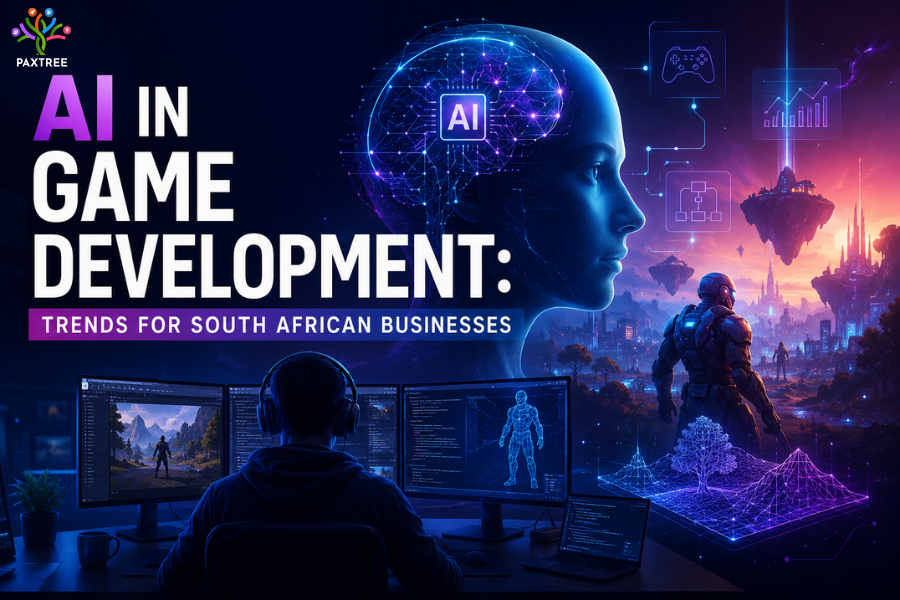
Artificial intelligence is reshaping the future of game development by helping businesses create smarter, faster, and more engaging digital experiences. For South African businesses, AI in game development is no longer an emerging technology reserved for large international studios. It has become a practical solution for reducing development costs, accelerating production, improving player engagement, and building innovative products that compete in local and global markets. Whether you’re developing a mobile game, an educational platform, a VR simulation, or an enterprise training application, AI enables development teams to deliver higher quality experiences while making better business decisions.
South Africa’s digital economy is evolving rapidly, driven by growing smartphone adoption, expanding cloud infrastructure, and increased investment in software innovation. As businesses continue to embrace digital transformation, game development is expanding beyond entertainment into industries such as education, healthcare, mining, tourism, financial services, and retail. Artificial intelligence is making this transition possible by helping organizations develop interactive applications that are more intelligent, scalable, and personalized than ever before.
The greatest advantage of AI is that it improves every stage of the development lifecycle. Instead of relying entirely on manual processes, development teams can automate repetitive tasks, analyze player behavior, optimize testing, and continuously improve gameplay based on real user data. The result is a faster development cycle, lower operational costs, and digital experiences that continue to evolve long after launch.
How AI in Game Development Is Transforming South African Businesses
Building a successful game today involves much more than writing code and designing graphics. Businesses must deliver personalized experiences, realistic gameplay, seamless performance across devices, and regular content updates to meet growing player expectations. Achieving these goals through traditional development methods alone often requires significant investment in time, resources, and specialized talent.
Artificial intelligence changes this by helping development teams work smarter rather than harder. Instead of replacing developers, artists, or designers, AI supports them by automating repetitive tasks and providing valuable insights that improve decision-making throughout production.
For businesses across South Africa, this creates measurable commercial advantages.
Faster Product Development
Speed is often the difference between leading a market and falling behind competitors. Businesses that release products quickly can validate ideas sooner, gather customer feedback, and adapt to changing market demands without lengthy development cycles.
AI accelerates production by helping teams:
- Automate repetitive coding and quality assurance tasks.
- Generate early concept art and design variations.
- Detect software bugs before manual testing begins.
- Organize development assets more efficiently.
- Reduce delays caused by repetitive production work.
For example, a startup developing a mobile learning game can use AI to automate early asset generation and testing, allowing developers to spend more time refining gameplay and educational content instead of performing repetitive manual tasks.
Lower Development Costs Without Compromising Quality
Managing a game development project often requires software engineers, UI and UX designers, artists, animators, testers, project managers, and infrastructure specialists. For startups and growing businesses, maintaining large in-house teams can quickly increase operational expenses.
Artificial intelligence helps optimize these resources by streamlining workflows rather than replacing skilled professionals.
Instead of manually testing thousands of gameplay scenarios, AI can automatically simulate player interactions, identify performance issues, and highlight balancing problems long before launch. Designers can also explore multiple creative concepts using AI-assisted tools before investing time in final production.
This reduces unnecessary revisions while allowing businesses to deliver commercial quality products with greater efficiency.
Better Decisions Through Player Analytics
Modern games generate valuable insights every second. Every completed level, purchase, session, achievement, and interaction provides information about how players engage with a product.
Artificial intelligence transforms this information into meaningful business intelligence.
Development teams can use AI-powered analytics to:
- Identify features that keep players engaged.
- Detect where players abandon the game.
- Improve monetization strategies.
- Personalize future content updates.
- Predict long-term player retention.
Rather than relying on assumptions, businesses make decisions based on measurable player behavior, resulting in more successful products and higher customer satisfaction.
AI Game Development Is Driving Innovation Beyond Entertainment
One of the biggest misconceptions about game development is that it only serves the entertainment industry. Today, interactive technologies powered by artificial intelligence are helping organizations solve real business challenges across multiple sectors.
In South Africa, businesses are increasingly investing in game-based applications to improve learning, customer engagement, operational efficiency, and workforce development.
Education
Educational institutions and EdTech companies are using AI-powered gamification to make learning more engaging and personalized. Adaptive learning systems analyze student progress and automatically adjust lessons based on individual performance, improving both engagement and knowledge retention.
Healthcare
Hospitals, medical universities, and healthcare providers are using interactive simulations to train professionals in realistic clinical environments. AI enables these simulations to respond dynamically, creating more practical learning experiences without exposing patients to unnecessary risks.
Mining
Mining organizations are adopting AI-powered training simulations to improve workplace safety. Employees can practice operating machinery, responding to emergencies, and following safety procedures within realistic virtual environments before entering active worksites.
Financial Services
Banks and financial institutions are beginning to explore gamified financial education platforms that help customers understand saving, investing, budgeting, and digital banking through interactive experiences. Artificial intelligence personalizes these journeys based on user behavior, making financial learning more engaging.
Key AI Technologies Driving Modern Game Development
Artificial intelligence is not a single technology but a collection of advanced capabilities that improve different stages of the game development lifecycle. From analyzing player behavior to creating realistic characters and automating testing, these technologies help businesses build smarter games while reducing development complexity.
Understanding how each technology works allows businesses to invest in solutions that align with their commercial objectives instead of adopting AI simply because it is a growing trend.
Machine Learning Creates Smarter Gaming Experiences
Machine learning is one of the most valuable technologies in AI in game development because it enables games to learn from player behavior and improve automatically over time.
Instead of following fixed rules, machine learning models analyze gameplay data to recognize patterns, predict outcomes, and optimize player experiences.
Businesses commonly use machine learning to:
- Analyze player engagement and behavior.
- Predict player retention and churn.
- Automatically adjust gameplay difficulty.
- Improve multiplayer matchmaking.
- Recommend personalized rewards and content.
- Detect fraudulent activities in online games.
For example, if data shows that many players leave after completing a particular level, AI can identify the issue and recommend gameplay adjustments before it affects long-term retention.
This allows businesses to make decisions based on measurable insights rather than assumptions.
Generative AI Accelerates Creative Development
Generative AI is changing how development teams approach creative production. Rather than replacing artists or designers, it helps generate ideas that professionals refine into finished assets.
Development teams use generative AI during early production to create:
- Character concepts.
- Environment layouts.
- Storyline ideas.
- Dialogue variations.
- Quest structures.
- Marketing visuals.
- User interface concepts.
For South African startups and SMEs, this significantly reduces the time required to move from concept to prototype, enabling businesses to validate ideas faster while controlling production costs.
The strongest studios treat generative AI as a creative assistant rather than a replacement for human expertise. Final artistic direction, storytelling, and gameplay design always remain in the hands of experienced professionals.
Natural Language Processing Improves Player Interaction
Modern players expect conversations that feel natural rather than scripted. Natural Language Processing (NLP) enables games to understand, process, and respond to human language in more realistic ways.
Businesses use NLP to build the following:
- Intelligent virtual assistants.
- AI-driven companions.
- Interactive educational games.
- Voice-enabled gameplay.
- Customer support systems inside gaming platforms.
As conversational AI continues to improve, businesses will be able to deliver richer storytelling experiences while improving accessibility for a wider audience.
Computer Vision Enhances AR and VR Experiences
Computer vision allows software to interpret images, gestures, and movement, making it an essential technology for AR and VR game development.
Businesses commonly use computer vision for:
- Motion tracking.
- Gesture recognition.
- Facial expression analysis.
- Object detection.
- Interactive AR applications.
- Immersive VR training simulations.
Industries such as healthcare, education, manufacturing, and tourism are increasingly adopting these technologies to create engaging digital experiences that go far beyond traditional gaming.
Intelligent NPCs Create More Immersive Gameplay
Non-player characters have evolved dramatically with artificial intelligence.
Traditional NPCs follow predefined scripts, meaning players eventually learn their behavior patterns. AI-powered NPCs, however, react dynamically based on player actions, making every interaction feel more authentic.
Modern AI enables NPCs to:
- Learn from previous player interactions.
- Adjust combat strategies automatically.
- Deliver context-aware conversations.
- Respond differently based on player choices.
- Support dynamic storytelling.
For businesses, smarter NPCs improve player engagement because every gameplay session feels unique. This increases replay value while strengthening long term player retention.
Procedural Content Generation Reduces Production Time
Designing every environment, building, character, and mission manually requires considerable time and creative resources.
Procedural content generation uses artificial intelligence to create large volumes of high-quality content automatically while allowing developers to maintain creative control.
Development teams use this technology to generate:
- Open-world environments.
- Landscapes and terrain.
- Buildings and interior spaces.
- Side quests and missions.
- Character variations.
- Collectibles and game assets.
Rather than replacing designers, AI provides multiple creative possibilities that teams can refine according to the game’s artistic direction.
For businesses developing large-scale games or immersive simulations, this significantly shortens production timelines while reducing repetitive work.
AI-Powered Game Testing Improves Product Quality
Testing remains one of the most time-consuming stages of game development. Modern games include thousands of possible interactions, making complete manual testing almost impossible.
Artificial intelligence improves quality assurance by automatically simulating player behavior across multiple gameplay scenarios.
AI-powered testing helps businesses:
- Detect bugs earlier in development.
- Identify gameplay balancing issues.
- Test performance across different devices.
- Reduce repetitive manual testing.
- Improve software stability before launch.
Earlier issue detection not only lowers development costs but also reduces the likelihood of negative reviews and expensive post-launch updates.
Why LiveOps and Player Analytics Matter
Successful games are no longer finished once they are launched. Today’s businesses rely on LiveOps to keep players engaged through regular updates, seasonal events, new challenges, and personalized rewards.
Artificial intelligence plays a critical role in LiveOps by continuously analyzing player behavior.
AI-powered analytics help businesses understand
- Which features players enjoy most.
- Where players lose interest.
- Which in-game events drive engagement.
- How different player groups spend money.
- Which updates improve long-term retention.
These insights enable development teams to make smarter product decisions while creating experiences that continue to evolve based on real player behavior.
Instead of relying on guesswork, businesses can confidently invest in features that deliver measurable commercial results.
Business Benefits of AI in Game Development
Artificial intelligence is more than a development tool. It is a business enabler that helps organizations reduce costs, improve operational efficiency, and create products that deliver long-term value. Companies investing in AI in game development are not simply building better games. They are creating scalable digital products that continuously improve through data and automation.
For South African businesses, this is particularly valuable as competition increases and customer expectations continue to evolve.
Improved Return on Investment
Game development requires significant investment in design, development, testing, infrastructure, and post-launch support. Artificial intelligence helps businesses maximize this investment by automating repetitive processes and reducing unnecessary production costs.
Some of the biggest financial benefits include:
- Lower quality assurance costs through automated testing.
- Faster production timelines that reduce development expenses.
- Better resource allocation across development teams.
- Reduced maintenance through predictive issue detection.
- Higher player retention, resulting in increased revenue opportunities.
Rather than increasing development budgets, businesses can achieve more with existing resources.
Faster Time to Market
Speed is essential in today’s competitive gaming industry. Launching a product several months earlier can provide a significant competitive advantage.
Artificial intelligence accelerates development by:
- Supporting rapid prototyping.
- Automating repetitive production tasks.
- Reducing debugging time.
- Simplifying asset management.
- Improving project planning through predictive analytics.
This allows businesses to respond more quickly to market trends while validating new ideas before competitors.
Better Customer Retention
Acquiring new players is often more expensive than retaining existing ones.
AI helps businesses improve customer loyalty by continuously analyzing player behavior and delivering personalized experiences.
Examples include:
- Personalized daily challenges.
- Dynamic reward systems.
- Intelligent content recommendations.
- Adaptive gameplay progression.
- Real-time engagement campaigns.
Businesses that understand player behavior can make informed decisions that increase long-term engagement and customer lifetime value.
Unity vs Unreal Engine for AI Game Development
Selecting the right game engine is one of the most important technical decisions during development. Both Unity and Unreal Engine support artificial intelligence, but they serve different business requirements.
| Feature | Unity | Unreal Engine |
| Best suited for | Mobile games, educational apps, AR solutions | AAA games, realistic simulations, VR experiences |
| Development speed | Faster MVP development | Better for large-scale productions |
| Learning curve | Easier for smaller teams | More advanced |
| Graphics | High quality | Industry-leading realism |
| AI integration | Excellent | Excellent |
| Cross platform support | Strong | Strong |
| Recommended for South African startups | ✔ Yes | ✔ Depending on project scope |
For businesses launching mobile applications, educational platforms, or customer engagement solutions, Unity often provides faster development cycles and lower production costs.
Unreal Engine is generally preferred for organizations developing visually intensive games, digital twins, industrial simulations, and immersive VR applications where graphical realism is a priority.
The best choice depends on business objectives rather than technology trends.
How to Successfully Implement AI in Game Development
Many organizations make the mistake of adopting artificial intelligence without first defining clear business goals. Successful implementation begins with understanding the problem AI should solve.
Step 1: Define Business Objectives
Before selecting technologies, identify what success looks like.
Examples include:
- Improving player engagement.
- Reducing production costs.
- Accelerating development.
- Increasing player retention.
- Enhancing gameplay realism.
- Creating personalized experiences.
Clear objectives help businesses measure the return on investment throughout the project.
Step 2: Start with a Minimum Viable Product
Rather than investing heavily in every planned feature, businesses should first develop an MVP.
Launching an MVP allows organizations to:
- Validate gameplay concepts.
- Gather real player feedback.
- Identify usability improvements.
- Reduce development risks.
- Prioritise future investments.
This agile approach enables continuous improvement based on real user behaviour instead of assumptions.
Step 3: Integrate AI Gradually
Artificial intelligence should support development rather than complicate it.
Businesses should introduce AI in phases, beginning with high-impact capabilities such as
- Automated game testing.
- Intelligent NPC behavior.
- Player analytics.
- Personalized gameplay.
- Content recommendations.
Once these features demonstrate measurable value, additional AI capabilities can be introduced as the product evolves.
Step 4: Monitor Performance After Launch
Launching a game is only the beginning.
Artificial intelligence continues delivering value after release by monitoring player engagement and identifying opportunities for improvement.
Businesses should continuously evaluate the following:
- Daily active users.
- Player retention.
- Session duration.
- Revenue performance.
- Gameplay balance.
- Customer satisfaction.
This data supports informed product decisions while reducing the risks associated with future updates.
AI in Game Development Across South African Industries
Although gaming remains the primary market, businesses across South Africa are increasingly using AI-powered game technologies to improve customer experiences and workforce development.
Education
Schools, universities, and EdTech companies use AI-driven gamification to personalize learning, improve student engagement, and measure educational outcomes.
Healthcare
Healthcare providers develop intelligent simulations for medical training, patient rehabilitation, and emergency response education.
Mining
Mining companies use realistic virtual simulations to train employees, improve safety awareness, and reduce workplace incidents.
Financial Services
Banks and fintech organizations are exploring gamified financial education platforms that help customers understand budgeting, saving, and investing through interactive experiences.
Tourism
Tourism operators use AI-powered AR and VR experiences to showcase destinations, museums, wildlife parks, and cultural attractions, providing visitors with immersive digital experiences before they travel.
Retail
Retail businesses use gamification to increase customer engagement through loyalty programs, reward systems, and personalized shopping experiences driven by artificial intelligence.
These industry applications demonstrate that AI in game development has evolved into a valuable business technology capable of supporting innovation across multiple sectors rather than entertainment alone.
Challenges of Implementing AI in Game Development
Artificial intelligence offers significant advantages, but successful implementation requires careful planning, the right technology, and experienced development teams. Businesses that treat AI as a strategic investment rather than a shortcut are more likely to achieve sustainable results.
Understanding these challenges early helps organizations minimize risks while maximizing the value of their investment.
Balancing AI with Human Creativity
Artificial intelligence can generate assets, analyze player behavior, and automate repetitive tasks, but it cannot replace human imagination.
Successful games are built on:
- Creative storytelling.
- Memorable characters.
- Emotional player experiences.
- Innovative gameplay mechanics.
- Strong artistic direction.
The most successful studios use AI to enhance productivity while allowing designers, artists, writers, and developers to focus on creativity and innovation.
Protecting Player Data
Modern AI systems rely on player data to deliver personalised gameplay and meaningful analytics. Businesses must ensure this information is collected and managed responsibly.
Best practices include:
- Collect only the data required for gameplay improvements.
- Implement secure storage and encryption.
- Be transparent about data collection.
- Follow South African privacy regulations and international compliance standards where applicable.
- Regularly review cybersecurity measures.
Building trust is just as important as building innovative games.
Choosing the Right AI Strategy
One of the biggest mistakes businesses make is attempting to implement every AI capability at once.
A better approach is to:
- Start with clear business objectives.
- Prioritise features that deliver measurable value.
- Validate results through player feedback.
- Expand AI capabilities gradually as the product grows.
This reduces implementation risks while ensuring every investment contributes to long-term business success.
How to Choose an AI Game Development Company in South Africa
Selecting the right development partner has a direct impact on project quality, delivery timelines, and long-term success. Beyond technical expertise, businesses should look for a company that understands commercial objectives and delivers scalable solutions designed for future growth.
Evaluate Industry Experience
Look for a company with proven experience in:
- AI game development.
- Mobile game development.
- Unity development.
- Unreal Engine development.
- AR and VR development.
- Multiplayer game development.
- Enterprise gamification.
A strong portfolio demonstrates the ability to solve complex business challenges while delivering engaging digital experiences.
Assess Technical Expertise
An experienced development partner should understand modern technologies including:
- Machine Learning.
- Generative AI.
- Natural Language Processing.
- Computer Vision.
- Cloud Gaming.
- LiveOps.
- Player Analytics.
- Cross-platform development.
This ensures your solution remains scalable as user expectations and business requirements evolve.
Prioritise Transparency and Collaboration
Successful AI projects depend on continuous communication.
Choose a company that offers:
- Agile development methodology.
- Regular project updates.
- Transparent pricing.
- Flexible engagement models.
- Post-launch maintenance and optimization.
Strong collaboration reduces development risks while keeping projects aligned with business goals.
Future Trends in AI in Game Development
Artificial intelligence is expected to become even more influential as gaming technology continues to evolve. Businesses that adopt these innovations early will be better positioned to create engaging products and respond quickly to changing customer expectations.
Hyper-Personalized Gaming
Future games will analyze player behavior in real time, delivering personalized missions, rewards, and gameplay experiences tailored to each individual.
AI-Generated Dynamic Worlds
Virtual environments will become increasingly responsive, allowing stories, characters, and missions to evolve based on player decisions rather than following fixed scripts.
Intelligent LiveOps
Artificial intelligence will continue improving LiveOps by automatically identifying engagement trends, predicting player churn, and recommending content updates that increase retention.
AI-Assisted Development Workflows
Development teams will increasingly rely on AI to automate repetitive production tasks, accelerate prototyping, and improve collaboration across multidisciplinary teams.
Greater Adoption Across Industries
Beyond entertainment, AI-powered game development will continue expanding into:
- Education.
- Healthcare.
- Financial services.
- Retail.
- Tourism.
- Manufacturing.
- Corporate training.
Interactive digital experiences will become an essential part of business transformation strategies across South Africa.
Final Thoughts
Artificial intelligence is no longer shaping the future of gaming-it is shaping the present. Businesses that embrace AI in game development today can accelerate innovation, improve operational efficiency, deliver personalized player experiences, and create products that remain competitive in a rapidly evolving digital landscape.
For South African organizations, the opportunity extends well beyond entertainment. AI-powered game development is helping businesses transform education, healthcare, tourism, retail, financial services, and workforce training through interactive digital experiences that drive measurable business outcomes.
The organizations that succeed over the next decade will be those that combine creative thinking with intelligent technologies, allowing them to respond faster to market demands while delivering experiences that customers genuinely value.
Ready to Build an AI-Powered Game?
Whether you’re planning a mobile game, an educational platform, an enterprise training simulator, or an immersive AR or VR experience, partnering with the right development team is essential for long-term success.
At Paxtree, we help businesses across South Africa turn innovative ideas into intelligent digital products. Our experienced developers specialize in AI game development, Unity, Unreal Engine, AR, VR, cross-platform development, and enterprise gamification, delivering scalable solutions that combine creativity, advanced technology, and measurable business value.
If you’re ready to build an AI-powered gaming solution that engages users and supports long-term business growth, contact Paxtree today. Our experts will help you design, develop, and launch a future-ready gaming experience tailored to your business goals.