AR/VR
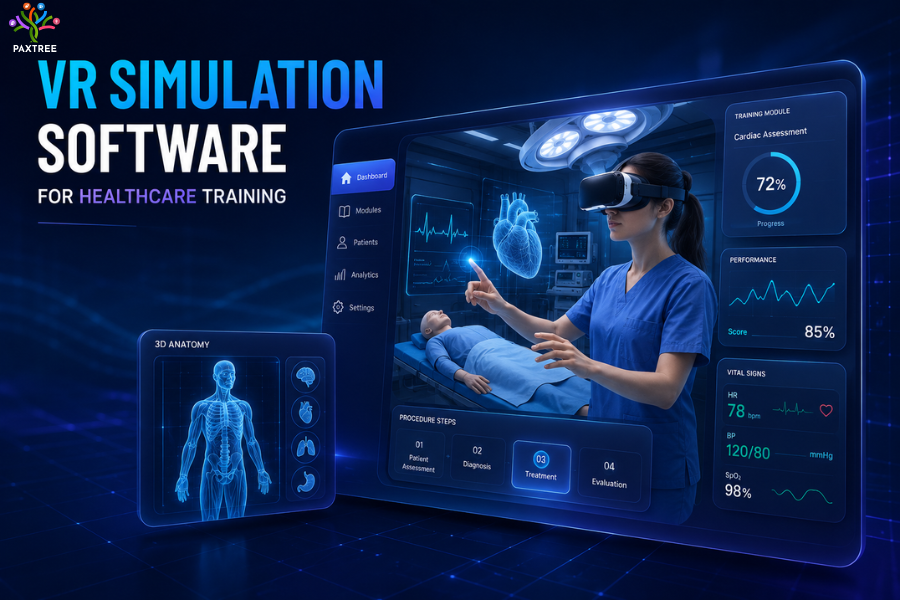
VR Simulation Software for Healthcare Training enables healthcare organizations to train doctors, nurses, surgeons, and medical students in immersive virtual environments where they can practice clinical procedures without risking patient safety. By combining virtual reality, artificial intelligence, and real-time performance analytics, these platforms improve learning outcomes, increase clinical confidence, reduce training costs, and help healthcare providers deliver better patient care.
Healthcare Training Is Evolving. Traditional Methods Alone Are No Longer Enough.
Every healthcare professional begins with the same goal: delivering safe, effective, and compassionate patient care. Achieving that goal requires more than classroom knowledge. It demands practical experience, confident decision-making, and the ability to respond quickly under pressure.
For decades, medical education has relied on lectures, textbooks, laboratory sessions, mannequins, cadaver training, and supervised clinical practice. While these methods remain essential, they also present significant limitations. Learners may encounter only a small number of real clinical cases, access to advanced equipment is often limited, and exposing patients to inexperienced practitioners is never ideal.
Healthcare itself is also changing rapidly. Hospitals are introducing robotic surgery, AI-assisted diagnostics, connected medical devices, and digital health platforms. As clinical workflows become more sophisticated, training methods must evolve alongside them.
This is why VR simulation software for healthcare training is becoming a strategic investment rather than an experimental technology.
Virtual reality allows healthcare professionals to enter highly realistic medical environments where they can perform procedures, make clinical decisions, and learn from mistakes in complete safety. Every simulation can be repeated, assessed, and improved until the learner reaches the required level of competence.
For hospitals, medical universities, nursing schools, healthcare startups, and enterprise healthcare providers, VR offers a practical way to build stronger clinical teams while improving patient outcomes.
What Is VR Simulation Software for Healthcare Training?
VR Simulation Software for Healthcare Training is an advanced learning platform that uses virtual reality to recreate realistic healthcare environments. Wearing a VR headset, learners can interact with virtual patients, medical equipment, hospital wards, operating theaters, emergency rooms, and intensive care units as though they were working in a real clinical setting.
Unlike traditional demonstrations, VR places learners at the center of the experience. They are required to assess symptoms, choose treatments, communicate with virtual patients, operate equipment, and respond to changing medical conditions in real time.
The software records every action throughout the session, providing detailed feedback on technical accuracy, decision-making, communication, and adherence to clinical protocols.
Modern healthcare VR platforms support training across a wide range of medical disciplines, including the following:
- General surgery
- Emergency medicine
- Trauma care
- Intensive care
- Nursing education
- Obstetrics and gynecology
- Cardiology
- Orthopedics
- Pediatrics
- Infection prevention
- Patient communication
- Medical equipment operation
Because scenarios can be repeated without additional physical resources, healthcare professionals gain more practical experience in less time while organizations maintain consistent training standards.
Why Healthcare Organizations Are Investing in VR Training
Healthcare leaders are under constant pressure to improve patient safety, reduce medical errors, accelerate workforce development, and control operational costs. Traditional training methods alone often struggle to meet these expectations.
Virtual reality addresses these challenges by delivering immersive, measurable, and highly scalable learning experiences.
Better Patient Safety
One of the greatest advantages of VR training is the ability to practice without placing patients at risk. Medical professionals can perform complex procedures, respond to emergencies, and learn from mistakes in a controlled virtual environment before applying those skills in clinical practice.
Consistent Training Across Every Location
Large healthcare organizations often operate multiple hospitals, clinics, or training centers. VR ensures that every learner follows the same standardized curriculum regardless of location, instructor, or available resources.
This consistency improves competency while supporting organizational quality standards.
Faster Skill Development
Clinical confidence develops through repetition. Virtual Reality allows learners to repeat procedures as many times as necessary without consuming medical supplies or requiring patient availability.
Repeated exposure helps healthcare professionals build muscle memory, improve decision-making, and become more comfortable handling high-pressure situations.
Lower Long Term Training Costs
Although implementing a VR platform requires an initial investment, it can significantly reduce long-term training expenses by minimizing the need for physical simulation equipment, consumable medical supplies, instructor time, travel, and dedicated training facilities.
For organizations training hundreds or thousands of healthcare professionals each year, these efficiencies create measurable cost savings.
Improved Knowledge Retention
People learn more effectively when they actively participate rather than simply observe. Immersive learning encourages healthcare professionals to think critically, solve problems, and apply knowledge in realistic situations.
This leads to stronger knowledge retention compared with passive learning methods such as lectures or instructional videos.
Preparing Teams for Rare Clinical Events
Many life-threatening emergencies occur infrequently, making it difficult for healthcare professionals to gain real-world experience before encountering them.
VR makes it possible to recreate scenarios such as cardiac arrest, mass casualty incidents, severe trauma, neonatal emergencies, and disaster response repeatedly. Teams can practice these situations until every role, decision, and communication step becomes familiar.
The Technology Behind Modern Healthcare VR Solutions
The most effective VR simulation software for healthcare training goes far beyond realistic graphics. It combines multiple advanced technologies to create intelligent, adaptive, and measurable learning experiences.
Artificial Intelligence
Artificial intelligence analyzes learner performance, identifies knowledge gaps, personalizes training pathways, and provides objective assessments based on clinical performance instead of subjective observation alone.
Advanced 3D Medical Visualization
High fidelity 3D environments accurately represent hospital infrastructure, surgical instruments, medical devices, and human anatomy. This level of realism helps learners become comfortable with clinical environments before entering them in real life.
Real-Time Performance Analytics
Every movement, decision, treatment step, and response is recorded. Training managers receive detailed reports showing learner progress, competency levels, common mistakes, and areas requiring additional practice.
Multi-User Collaboration
Modern VR platforms enable doctors, nurses, anesthetists, and emergency responders to participate in the same simulation from different locations. This strengthens communication, leadership, and teamwork, all of which are essential during critical medical situations.
Cloud-Based Learning
Cloud integration allows healthcare organizations to update training modules, manage users, track progress, and deliver consistent education across multiple hospitals, universities, and healthcare facilities without maintaining separate systems.
Why This Matters for the Future of Healthcare
Healthcare is entering a new era where digital technologies are reshaping how professionals learn, collaborate, and deliver care. Organizations that invest in immersive training today are not simply adopting new software-they are building a workforce that is more confident, better prepared, and capable of delivering safer outcomes for patients.
As healthcare systems continue to evolve across South Africa and globally, VR simulation software is becoming a key component of modern medical education and professional development.
Core Features Every VR Healthcare Training Platform Should Include
Not every virtual reality solution is designed for healthcare. A gaming application may deliver impressive visuals, but medical training demands far greater accuracy, reliability, and educational value. The right VR simulation software for healthcare training should mirror real clinical workflows while providing measurable learning outcomes.
Immersive Clinical Environments
A realistic environment is the foundation of effective simulation. Learners should feel as though they are working inside an actual healthcare facility rather than a digital model.
High-quality VR healthcare platforms recreate the following:
- Emergency departments
- Operating theatres
- Intensive Care Units (ICUs)
- Patient wards
- Diagnostic laboratories
- Ambulances
- Outpatient clinics
- Rehabilitation centres
When environments closely match real healthcare settings, professionals become familiar with equipment placement, workflows, and clinical procedures before entering real practice.
Intelligent Virtual Patients
Static simulations are no longer enough. Modern platforms use intelligent virtual patients that react dynamically to every clinical decision.
For example, if the wrong medication is administered or treatment is delayed, the patient’s condition changes accordingly. If the correct intervention is performed, vital signs stabilize and recovery begins.
This realistic behavior teaches healthcare professionals to think critically instead of simply following memorized steps.
Procedure-Based Learning
Healthcare training must reflect the complexity of real clinical work. Effective VR software supports structured simulations for procedures such as the following:
- CPR and advanced life support
- Airway management
- Endotracheal intubation
- Intravenous cannulation
- Catheter insertion
- Blood sampling
- Trauma assessment
- Wound management
- Infection control
- Preoperative preparation
- Surgical assistance
- Postoperative care
Repeating these procedures helps learners develop confidence and consistency before working with real patients.
AI-Powered Assessment
One of the biggest advantages of modern VR healthcare software is automated performance evaluation.
Artificial intelligence measures clinical performance based on predefined criteria instead of relying only on instructor observations.
Typical assessment metrics include the following:
- Clinical decision-making
- Procedure accuracy
- Time taken to complete tasks
- Patient safety compliance
- Communication skills
- Treatment sequence
- Error frequency
- Overall competency score
This allows educators to identify strengths and address learning gaps much earlier.
Performance Analytics Dashboard
Training managers need more than completion certificates. They need meaningful data.
A comprehensive analytics dashboard provides insights such as the following:
- Individual learner progress
- Department performance
- Skill improvement trends
- Assessment history
- Competency reports
- Certification readiness
These reports simplify workforce planning while supporting regulatory and accreditation requirements.
Real-World Applications of VR Simulation Software in Healthcare
The flexibility of VR makes it valuable across nearly every healthcare discipline. Organizations are using immersive simulations to improve both technical expertise and soft skills.
Hospital Workforce Training
Hospitals use VR to train newly hired clinicians, standardize clinical protocols, and prepare teams for high-pressure situations.
Instead of waiting for rare emergencies, professionals can experience them repeatedly in a virtual environment until they respond with confidence.
Medical Universities
Universities are integrating virtual reality into medical education to supplement classroom learning with practical experience.
Students can explore anatomy in three dimensions, examine physiological systems, diagnose virtual patients, and rehearse procedures long before entering clinical rotations.
This creates a stronger bridge between theory and practice.
Nursing Education
Nursing schools benefit from VR because students gain practical exposure without relying solely on clinical placements.
Common training modules include:
- Patient assessment
- Medication administration
- IV therapy
- Infection prevention
- Patient communication
- Critical care
- Emergency response
This practical experience prepares graduates for real hospital environments.
Emergency Medical Services
Emergency responders operate in unpredictable environments where every second matters.
VR simulations recreate situations such as the following:
- Road traffic accidents
- Cardiac arrest
- Fire emergencies
- Natural disasters
- Mass casualty incidents
- Hazardous material exposure
By practicing these scenarios repeatedly, emergency teams improve coordination, communication, and decision-making.
Surgical Education
Surgical training is one of the fastest-growing applications of healthcare VR.
Residents and surgeons can rehearse procedures multiple times before entering the operating theater.
This supports:
- Better hand-eye coordination
- Greater procedural accuracy
- Improved confidence
- Reduced operating room errors
- Continuous professional development
Medical Device Training
Healthcare organizations frequently introduce new diagnostic and treatment technologies.
VR allows clinicians to become familiar with equipment before using it in real clinical environments.
Examples include:
- MRI systems
- CT scanners
- Ultrasound devices
- Ventilators
- Robotic surgery platforms
- Patient monitoring systems
Business Benefits Beyond Medical Education
Although patient safety remains the primary objective, VR also delivers measurable business value.
Faster Employee Onboarding
New healthcare professionals become productive more quickly because they experience realistic workflows before entering live clinical settings.
Reduced Medical Errors
Repeated practice improves consistency and helps healthcare professionals avoid common procedural mistakes.
Even small reductions in clinical errors can have a significant impact on patient outcomes and operational efficiency.
Standardized Training
Healthcare organizations operating across multiple cities or countries can deliver identical learning experiences to every employee.
This consistency supports quality assurance and compliance initiatives.
Better Return on Training Investment
Traditional simulation centers require ongoing spending on consumables, equipment maintenance, instructor time, and facility management.
VR reduces many of these recurring costs while allowing unlimited practice sessions.
Scalable Learning
Once training modules are developed, organizations can expand learning programs across hospitals, universities, and healthcare networks without rebuilding physical infrastructure.
VR Healthcare Training vs Traditional Medical Training
Healthcare organizations often ask whether virtual reality replaces traditional education.
The answer is no.
Instead, it enhances existing learning methods by providing practical experience that traditional approaches cannot always deliver.
| Traditional Training | VR Simulation Training |
| Limited practical exposure | Unlimited practice opportunities |
| Dependent on patient availability | Independent of clinical schedules |
| Instructor availability required | Self-paced learning supported |
| Difficult to standardize | Consistent training across locations |
| Limited performance tracking | Detailed analytics and competency reports |
| Higher long-term operational costs | Lower recurring training costs |
| Passive observation | Active, immersive participation |
The strongest healthcare training programs combine classroom education, supervised clinical practice, and virtual reality simulations to create a well-rounded learning experience.
How Artificial Intelligence Is Making VR Healthcare Training Smarter
Artificial intelligence is transforming immersive learning from a static simulation into an adaptive educational platform.
Instead of delivering the same experience to every learner, AI continuously analyzes performance and adjusts scenarios based on individual progress.
Examples include:
Personalized Learning Paths
AI identifies weak areas and recommends additional simulations that focus on specific clinical skills.
Adaptive Clinical Scenarios
Virtual patients can develop new symptoms, respond differently to treatments, or present unexpected complications, encouraging learners to think critically rather than memorize steps.
Automated Feedback
Detailed performance reports are generated immediately after each simulation, helping learners understand where they performed well and what requires further practice.
Predictive Learning Analytics
Healthcare organizations can identify competency gaps across departments and provide targeted training before those gaps affect patient care.
How to Develop VR Simulation Software for Healthcare Training
Developing VR simulation software for healthcare training requires more than technical expertise. It involves understanding clinical workflows, healthcare regulations, user experience, and immersive technologies. A successful platform should provide realistic training while remaining scalable, secure, and easy to manage.
Below is a typical development roadmap followed by healthcare technology companies.
1. Define Training Objectives
Every project starts by identifying the learning outcomes.
Common objectives include:
- Improving surgical skills
- Standardizing nursing education
- Emergency response training
- Medical device onboarding
- Continuing medical education
- Hospital staff orientation
Clear objectives help determine the simulation scenarios, user roles, reporting requirements, and assessment criteria.
2. Design Clinical Workflows
The next step is mapping real healthcare processes into virtual environments.
This includes:
- Patient admission
- Clinical assessment
- Diagnosis
- Treatment planning
- Medical procedures
- Post-treatment evaluation
- Emergency escalation
Healthcare professionals should be involved during this stage to ensure every workflow reflects real clinical practice.
3. Build Immersive 3D Environments
Once the workflows are finalized, designers create highly detailed 3D models of hospitals, operating rooms, emergency departments, medical devices, and patient environments.
Realistic lighting, equipment placement, animations, and environmental sounds make the simulations more engaging and improve learner confidence.
4. Develop Interactive Simulations
Developers transform static environments into interactive experiences where learners can:
- Examine patients
- Use medical equipment
- Perform procedures
- Administer medication
- Communicate with virtual patients
- Respond to emergencies
- Collaborate with team members
Each action triggers realistic system responses, creating an immersive learning experience.
5. Integrate Artificial Intelligence
AI makes the platform more intelligent by:
- Personalizing learning paths
- Evaluating performance automatically
- Adapting patient conditions
- Identifying skill gaps
- Generating detailed assessment reports
This enables continuous improvement without increasing instructor workload.
6. Test and Validate
Healthcare simulations must undergo extensive testing before deployment.
Validation includes:
- Clinical accuracy
- User experience
- Performance optimization
- Device compatibility
- Data security
- Scenario consistency
Medical experts should verify that every simulation aligns with current clinical guidelines.
What Influences the Cost of VR Healthcare Simulation Software?
There is no fixed price for developing a VR healthcare training platform. The total investment depends on the project’s complexity, features, and deployment requirements.
Some of the biggest cost factors include:
Number of Training Modules
A platform with one emergency response simulation costs significantly less than a solution covering surgery, nursing, intensive care, and diagnostics.
Level of Realism
Highly detailed environments, realistic patient behavior, voice interactions, and advanced animations require additional development effort.
AI Capabilities
Features such as intelligent virtual patients, automated assessments, predictive analytics, and adaptive learning increase development complexity while providing greater long-term value.
Multi-User Collaboration
Supporting multiple participants in the same simulation requires secure networking, synchronization, and real-time communication.
Device Compatibility
Organizations may require support for Meta Quest, HTC Vive, Pico, Windows Mixed Reality, or desktop VR systems.
Integration Requirements
Connecting the platform with Learning Management Systems (LMS), hospital information systems, or cloud infrastructure also affects project scope.
Rather than focusing only on development cost, healthcare organizations should evaluate the long-term return on investment. A well-designed VR platform can reduce recurring training expenses, improve workforce readiness, and support better patient outcomes for years.
Common Challenges and How to Overcome Them
Implementing VR in healthcare is a strategic initiative, but success depends on careful planning.
Challenge: Resistance to New Technology
Some healthcare professionals may hesitate to adopt new training methods.
Best practice: Introduce VR alongside existing programs and provide guided onboarding to build confidence.
Challenge: Content Becoming Outdated
Medical guidelines evolve over time.
Best practice: Develop modular content that can be updated quickly without rebuilding the entire platform.
Challenge: Hardware Management
Organizations with multiple locations may find device management difficult.
Best practice: Use centralized cloud management for software updates, user access, and reporting.
Challenge: Measuring Success
Without clear metrics, it is difficult to evaluate training effectiveness.
Best practice: Track completion rates, competency scores, assessment results, knowledge retention, and learner confidence over time.
The Future of VR Healthcare Training
The next generation of healthcare education will combine virtual reality with artificial intelligence, data analytics, and immersive collaboration.
Some of the most promising developments include:
AI-Driven Virtual Mentors
Learners will receive real-time coaching from AI assistants that provide guidance during procedures and explain mistakes as they occur.
Digital Twin Simulations
Hospitals will create digital twins of operating theaters and clinical environments, allowing professionals to rehearse procedures before treating actual patients.
Mixed Reality Learning
Future training will blend digital content with physical environments, enabling healthcare professionals to interact with both simultaneously.
Remote Global Collaboration
Medical experts from different countries will participate in shared virtual training sessions, improving knowledge exchange and standardizing education worldwide.
Continuous Competency Monitoring
Instead of annual assessments, healthcare organizations will continuously evaluate clinical skills through data-driven simulation programs.
These innovations will help healthcare providers deliver safer, more consistent, and more effective patient care.
Why Choose Paxtree for VR Healthcare Software Development?
Building healthcare software requires expertise in both technology and clinical workflows. At Paxtree, we develop immersive VR solutions that are tailored to the needs of hospitals, medical universities, healthcare startups, research institutions, and enterprise healthcare organizations.
Our team combines experience in virtual reality, artificial intelligence, cloud technologies, and custom software development to create platforms that are practical, scalable, and future-ready.
Our capabilities include:
- Custom VR simulation software development
- Healthcare software development
- AI-powered training platforms
- Interactive 3D application development
- Enterprise software integration
- Cloud-based learning solutions
- Cross-platform VR applications
- Analytics and reporting dashboards
- Ongoing maintenance and feature enhancements
Whether your goal is to improve clinical education, reduce training costs, or accelerate digital transformation, Paxtree can help you build a solution that delivers measurable business value and better learning outcomes.
Conclusion
Healthcare training is entering a new era where immersive technology is becoming as important as traditional education. VR simulation software for healthcare training empowers organizations to create safer learning environments, strengthen clinical skills, and prepare professionals for real-world medical challenges before they ever interact with a patient.
By combining virtual reality, artificial intelligence, realistic clinical simulations, and performance analytics, healthcare providers can improve workforce readiness while reducing long-term training costs and supporting higher standards of patient care.
For organizations in South Africa and across the globe, investing in VR healthcare training is no longer just about innovation. It is about building resilient healthcare teams, improving operational efficiency, and delivering better outcomes in an increasingly complex medical landscape.
If you are planning to develop a custom VR healthcare training platform, partnering with an experienced technology company can make all the difference. Paxtree works closely with healthcare organizations to design secure, scalable, and engaging VR solutions that align with your clinical goals and long-term growth strategy.
Ready to Build Custom VR Simulation Software for Healthcare Training?
Whether you’re a hospital looking to improve clinical training, a medical university modernizing education, or a healthcare startup developing innovative digital solutions, the right VR platform can transform how healthcare professionals learn, practice, and perform.
At Paxtree, we specialize in designing and developing custom VR simulation software for healthcare training that combines immersive virtual reality, AI-powered assessments, realistic medical simulations, and scalable cloud technologies. Every solution is tailored to your clinical objectives, regulatory requirements, and long-term business goals.
From interactive surgical simulations and emergency response training to nursing education and medical device onboarding, our team helps healthcare organizations build engaging, future-ready learning experiences that improve workforce readiness and patient safety.
Ready to bring your healthcare training vision to life? Contact Paxtree today to discuss your project, explore custom VR healthcare solutions, and discover how immersive technology can help your organization deliver smarter medical education and better patient outcomes.