Mobile App Development
Introduction
Receiving a Google Play Developer Account suspension email can be one of the most stressful moments for any app publisher. Whether you are an independent Android developer, startup founder, SaaS company, or mobile app development agency, a suspension can instantly affect your visibility, downloads, active users, revenue, and business growth.
For many organizations, Google Play is more than just an app marketplace. It serves as the primary distribution channel for Android applications and often represents years of development effort, marketing investment, customer acquisition, and brand building. When a developer account is suspended, all associated applications may disappear from the Play Store, preventing new users from discovering or downloading them.
The situation becomes even more frustrating because Google rarely provides a lengthy explanation. Most developers receive a policy notice, a brief reason for the enforcement action, and instructions regarding the appeal process. As a result, many developers are left wondering whether their account can be recovered, what caused the suspension, and what steps should be taken next.
The good news is that not every suspension is permanent. Many developers successfully recover their accounts after identifying the root cause of the violation, correcting compliance issues, and submitting a well-prepared appeal. However, success depends on understanding how Google’s enforcement system works and approaching the recovery process strategically.
In this guide, you will learn why Google suspends developer accounts, how different enforcement actions work, the most common policy violations, what to do immediately after a suspension, and how to prepare for a successful recovery process.
Quick Answer
A suspended Google Play Developer account can often be recovered by identifying the policy violation, correcting compliance issues, conducting a complete account audit, and submitting a detailed appeal with supporting evidence. Recovery success depends on the severity of the violation and the quality of the corrective actions presented to Google.
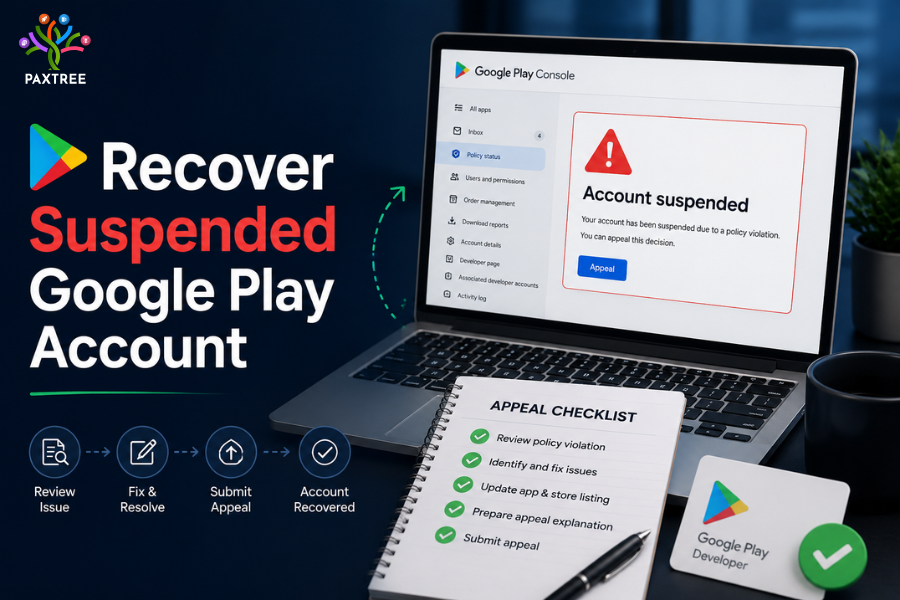
How to Recover a Suspended Google Play Developer Account
- Review the suspension email.
- Identify the policy violation.
- Audit all apps and account settings.
- Fix compliance issues.
- Gather supporting documentation.
- Prepare a detailed appeal.
- Submit the appeal to Google.
- Monitor responses and provide additional evidence if requested.
Understanding Google’s Enforcement System
Before attempting to recover a suspended Google Play Developer account, it is important to understand how Google enforces its policies.
Many developers mistakenly believe that all enforcement actions are the same. In reality, Google uses multiple levels of enforcement depending on the severity of the violation, the developer’s history, and the potential impact on users.
Understanding these enforcement levels can help developers better assess their situation and determine the most appropriate recovery strategy.
Policy Warning
A policy warning is generally the least severe enforcement action.
Google may issue a warning when an application violates a policy but the issue can be corrected without immediate removal. Developers are typically given a deadline to resolve the violation before stronger enforcement actions are applied.
Examples of situations that may trigger a warning include inaccurate metadata, missing disclosures, or certain permission-related concerns.
Developers should never ignore policy warnings. Many account suspensions begin with unresolved warnings that eventually escalate into more serious enforcement actions.
App Rejection
App rejection occurs when Google refuses to approve a new application or update submission.
In this scenario, the developer account remains active, but the affected application cannot be published until the identified issues are resolved.
Common reasons for rejection include:
- Policy violations
- Incomplete disclosures
- Permission misuse
- Store listing issues
- Technical compliance problems
Although app rejection can be frustrating, it is generally easier to resolve than account-level enforcement.
App Removal
An app removal affects a specific application rather than the entire developer account.
Google may remove an app from the Play Store if it violates one or more policies. Existing users may still have access to the application on their devices, but new downloads become unavailable until the issue is addressed.
App removals often occur because of:
- Privacy violations
- Restricted content
- Intellectual property complaints
- Misleading claims
- Security concerns
Developers should treat app removals seriously because repeated removals can contribute to account suspension risk.
Developer Account Suspension
A developer account suspension is one of the most serious enforcement actions available before termination.
When a suspension occurs, the entire account is affected.
The consequences may include:
- Removal of all published applications
- Loss of visibility within Google Play
- Inability to submit updates
- Interruption of revenue streams
- Damage to brand reputation
This is typically the stage where developers begin searching for account recovery solutions.
Developer Account Termination
Termination is Google’s most severe enforcement action.
A terminated account may lose access to Google Play permanently, and future publishing opportunities may be significantly restricted.
Google often reserves termination for serious policy violations, repeated non-compliance, fraudulent activity, or harmful behavior that threatens users or the platform.
Because recovery options become more limited after termination, developers should take suspensions seriously and address issues before they escalate further.
Suspension vs Termination: Understanding the Difference
One of the most common misconceptions among developers is confusing account suspension with account termination.
Although both enforcement actions can remove applications from Google Play, they are not identical.
| Factor | Suspension | Termination |
|---|---|---|
| Account Access | Restricted | Usually permanently removed |
| App Availability | Removed | Removed |
| Appeal Opportunity | Available | Limited |
| Recovery Potential | Moderate | Difficult |
| Future Publishing | Possible after reinstatement | Often restricted |
Understanding this distinction helps developers set realistic expectations during the recovery process.
Recovery Difficulty Table
| Suspension Cause | Recovery Difficulty | Success Potential |
|---|---|---|
| Metadata Violations | Low | High |
| Privacy Policy Issues | Medium | High |
| Spam Apps | Medium | Moderate |
| Association Policy | High | Moderate |
| Malware Violations | Very High | Low |
Why Google Play Compliance Matters
Google Play serves billions of Android users worldwide and hosts millions of applications across multiple categories. To maintain user trust and platform quality, Google continuously reviews applications for security risks, privacy concerns, deceptive practices, and policy violations.
As Android adoption continues to grow, policy enforcement has become increasingly strict. Developers who treat compliance as an ongoing process are far more likely to avoid suspensions and maintain long-term success on the platform.
Why Google Play Developer Accounts Get Suspended
Google’s goal is to maintain a safe, trustworthy, and high-quality marketplace for Android users.
Most suspensions occur because Google’s systems identify behavior that violates platform policies or creates risks for users.
While every case is unique, several categories account for the majority of developer account suspensions.
Repeated Policy Violations
Repeated violations are one of the most common causes of account suspension.
Google generally prefers corrective action before imposing severe penalties. Developers often receive warnings, app removals, or compliance notices before account-level enforcement occurs.
However, when violations continue despite previous warnings, Google may conclude that stronger action is necessary.
Examples include:
Google may suspend accounts that repeatedly violate metadata policies, use misleading app descriptions, or provide inaccurate disclosures. When these issues occur repeatedly, Google may view them as a pattern of non-compliance rather than isolated mistakes.
Many developers focus only on the latest violation while overlooking a broader history of compliance concerns.
Google’s review process often evaluates patterns rather than isolated incidents.
User Data and Privacy Violations
Privacy compliance has become increasingly important in recent years.
Google expects developers to clearly explain how user data is collected, stored, processed, and shared.
Problems often arise when applications collect sensitive information without proper disclosure or request permissions that appear unnecessary.
Common privacy-related concerns include:
- Missing privacy policies
- Insufficient consent mechanisms
- Undisclosed data collection
- Improper data sharing practices
- Misuse of sensitive permissions
As privacy regulations continue evolving globally, enforcement in this area is becoming increasingly strict.
Spam and Low-Quality Applications
Google actively works to reduce low-value content within the Play Store.
Applications that provide limited user value or appear designed solely to generate downloads may attract enforcement actions.
Examples include:
- Duplicate applications
- Template-based apps
- Mass-produced apps
- Minimal functionality apps
- Keyword-stuffed listings
Developers operating large portfolios of similar applications should pay particular attention to Google’s spam policies.
Misleading User Experiences
User trust is fundamental to the Google Play ecosystem.
Applications that intentionally mislead users may face severe enforcement actions.
This includes situations where app listings, screenshots, advertisements, or functionality create false expectations.
Common examples include:
- Fake functionality claims
- Misleading screenshots
- Hidden charges
- Deceptive subscription flows
- Manipulated reviews
Even if the application itself functions correctly, misleading promotional practices can trigger compliance concerns.
Malware and Security Violations
Security-related violations are among the most serious issues Google evaluates.
Applications that compromise user safety may face immediate enforcement actions.
Potential triggers include:
- Spyware behavior
- Credential theft
- Malicious code
- Unauthorized downloads
- Harmful background processes
Google places user safety above all other considerations, making recovery more difficult when security concerns are involved.
Intellectual Property Violations
Developers sometimes underestimate the importance of intellectual property compliance.
Using copyrighted content, trademarks, logos, or protected materials without authorization can result in complaints and enforcement actions.
Examples include:
- Unauthorized brand usage
- Copyright infringement
- Trademark violations
- Content theft
- Unlicensed media
Repeated intellectual property complaints may contribute to broader account-level enforcement.
Understanding Google’s Association Policy
Association-related suspensions are among the most confusing and controversial enforcement actions developers encounter.
Many developers receive suspension notices despite believing their applications fully comply with Google Play policies.
In these cases, the issue may not involve the application itself but rather Google’s determination that the account is associated with another developer account that was previously suspended or terminated.
Google uses various signals to identify potential associations.
These signals may include:
- Shared devices
- Shared internet connections
- Shared IP addresses
- Shared payment methods
- Shared ownership structures
- Shared contact information
- Shared business relationships
The purpose of this policy is to prevent bad actors from repeatedly creating new accounts after enforcement actions.
However, legitimate developers can sometimes be affected when associations are detected incorrectly or when business relationships create unintended connections.
Because association-related suspensions involve account relationships rather than application compliance, they often require a different recovery strategy than traditional policy violations.
Developers facing association-based suspensions should carefully document ownership structures, operational independence, and any evidence demonstrating separation from previously suspended accounts.
What To Do Immediately After Receiving a Suspension Notice
The first few hours after receiving a suspension notice are critical.
Unfortunately, this is when many developers make decisions that reduce their chances of recovery.
The most important thing to do is remain calm and avoid reacting emotionally.
A suspension can feel personal because it affects your business, reputation, and revenue. However, Google’s review process is based on evidence and compliance, not emotion.
Start by carefully reviewing the suspension email multiple times.
Pay close attention to:
- The policy category mentioned
- The type of enforcement action applied
- Any examples provided
- Appeal instructions
- Relevant policy references
Many developers submit weak appeals simply because they misunderstood the actual issue identified by Google.
Avoid creating a new developer account in an attempt to bypass the suspension.
This is one of the most common mistakes developers make.
Google’s systems are designed to detect related accounts, and attempting to circumvent enforcement may create additional complications.
Instead, focus entirely on understanding the reason for the suspension and preparing a structured recovery strategy.
The actions you take immediately after receiving the suspension notice often have a significant impact on the outcome of the recovery process.
Conducting a Complete Compliance Audit Before Filing an Appeal
One of the biggest mistakes developers make after a suspension is submitting an appeal immediately without conducting a detailed compliance review.
Many assume Google made a mistake and focus entirely on convincing the review team to reverse the decision. Unfortunately, this approach rarely works.
Google wants evidence that you understand the issue and have taken meaningful corrective action.
Before preparing an appeal, perform a comprehensive audit of every application, policy, disclosure, and business process connected to the developer account.
Even if Google references a specific violation, additional compliance issues may exist elsewhere.
A thorough audit demonstrates responsibility and increases the likelihood of a successful review.
Review Application Permissions
Permissions are one of the first areas that should be examined.
Google expects every permission requested by an application to directly support core functionality.
Ask yourself:
- Does the app genuinely require this permission?
- Is the permission explained to users?
- Is there a less intrusive alternative?
Developers sometimes inherit old permissions from previous versions and forget to remove them. Over time, these unnecessary permissions can raise compliance concerns.
Pay special attention to:
- Location access
- Camera access
- Microphone access
- SMS permissions
- Contact access
- Storage permissions
If a permission is no longer required, remove it.
Audit Privacy Policies
Privacy-related enforcement actions have increased significantly in recent years.
Your privacy policy should clearly explain:
- What data is collected
- Why the data is collected
- How data is stored
- How data is processed
- Whether data is shared with third parties
- How users can request deletion
Many suspensions occur because privacy policies are incomplete, outdated, or inconsistent with actual application behavior.
Compare the privacy policy against the app’s real functionality.
Any mismatch should be corrected immediately.
Evaluate Data Collection Practices
Beyond the privacy policy itself, review the actual data handling process.
Consider questions such as the following:
- Is user consent collected properly?
- Are users informed before sensitive data collection?
- Are third-party SDKs collecting information?
- Is collected data genuinely necessary?
Google increasingly evaluates transparency and user control when reviewing applications.
Review Store Listing Content
A surprising number of suspensions originate from store listing issues rather than app functionality.
Review every public-facing element carefully.
This includes:
- App title
- Short description
- Full description
- Screenshots
- Feature graphics
- Promotional videos
Every claim should accurately represent the application’s capabilities.
Avoid exaggerations, misleading promises, or unsupported statements.
Analyze Third-Party SDKs
Many developers focus exclusively on their own code while overlooking external SDKs.
Advertising networks, analytics tools, payment gateways, and social integrations may introduce compliance risks.
Review:
- Data collection behavior
- Permission usage
- Privacy practices
- Security requirements
A third-party SDK issue can become your compliance issue.
Step-by-Step Recovery Process
Once the audit is complete, developers can begin the actual recovery process.
A structured approach significantly improves the chances of success.
Step 1: Identify the Real Cause
The suspension email provides clues, but it may not always reveal the entire story.
Many developers focus on the wording of the email without investigating deeper issues.
Ask:
- What policy category was referenced?
- Have there been previous warnings?
- Were apps removed previously?
- Have there been recent updates?
- Did any new SDKs get added?
The objective is identifying the root cause rather than simply responding to symptoms.
Step 2: Correct Every Possible Issue
Do not limit your corrections to the exact issue mentioned by Google.
A stronger strategy is resolving all potential compliance concerns.
Examples include:
- Updating privacy disclosures
- Removing risky permissions
- Improving consent flows
- Revising app listings
- Updating policies
- Removing problematic SDKs
This demonstrates a proactive commitment to compliance.
Step 3: Gather Supporting Documentation
Evidence strengthens appeals.
Useful documentation may include:
- Updated screenshots
- Compliance reports
- Privacy policy revisions
- Permission explanations
- Business registration records
- Developer identification documents
The goal is providing objective proof that improvements have been made.
Step 4: Prepare Your Appeal
A strong appeal follows a logical structure.
Avoid emotional language.
Avoid blaming Google.
Avoid lengthy explanations about financial losses.
Focus on:
- Understanding the issue
- Corrective actions taken
- Future prevention measures
Google reviewers evaluate compliance, not business impact.
How to Write a Strong Google Play Suspension Appeal
Many appeals fail because they are too generic.
Statements such as:
“We worked very hard on this app.”
or
“Please restore our account.”
provide little value.
Instead, focus on demonstrating accountability.
A strong appeal generally contains four sections.
Acknowledge the Issue
Start by showing that you understand the concern.
Example:
After reviewing the suspension notice, we conducted a comprehensive compliance review of our applications and publishing practices to identify the underlying issue.
Explain the Root Cause
Describe what was discovered during the investigation.
Be specific.
Avoid vague explanations.
The reviewer should clearly understand what happened.
Describe Corrective Actions
This is the most important section.
Explain:
- What was fixed
- What was removed
- What was updated
- What policies were revised
The more specific the details, the stronger the appeal becomes.
Explain Future Prevention Measures
Google wants confidence that the issue will not occur again.
Describe:
- Internal review processes
- Compliance audits
- Team training
- Ongoing monitoring procedures
Future prevention demonstrates long-term commitment to policy compliance.
Real-World Suspension Scenarios
Understanding common suspension situations can help developers identify the best recovery approach.
Scenario 1: Metadata Policy Violation
A developer repeatedly used misleading keywords and exaggerated claims within app descriptions.
Several warnings were ignored over time.
Eventually, the account received suspension-level enforcement.
Recovery required:
- Rewriting all metadata
- Removing misleading language
- Reviewing every listing
- Submitting a detailed appeal
Scenario 2: User Data Policy Violation
An application collected location information but failed to properly disclose the purpose within the privacy policy.
Google considered the disclosure inadequate.
Recovery involved:
- Updating disclosures
- Improving consent screens
- Revising privacy policies
- Documenting compliance improvements
Scenario 3: Association-Based Suspension
A developer worked with a business partner who previously owned a terminated account.
Google detected connections between the accounts.
Recovery required evidence demonstrating:
- Independent ownership
- Separate operations
- Separate financial controls
- Separate development activities
Association cases are often among the most complex suspension scenarios.
Scenario 4: Spam App Enforcement
A publisher maintained dozens of nearly identical applications.
Google classified the portfolio as low-value content.
Recovery required:
- Consolidating applications
- Removing duplicate content
- Improving app quality
- Demonstrating user value
Why Google Play Appeals Get Rejected
Understanding rejection reasons is just as important as understanding successful appeals.
Many rejected appeals share common characteristics.
Generic Responses
Google expects evidence.
Generic promises often fail because they do not demonstrate meaningful corrective action.
No Root Cause Analysis
Developers sometimes explain the impact of the suspension without explaining the actual violation.
Reviewers need to see understanding of the problem.
Lack of Documentation
Claims without supporting evidence carry limited value.
Documentation improves credibility.
Repeated Appeals With No Changes
Submitting the same appeal repeatedly rarely changes the outcome.
Every new appeal should contain additional information or corrective actions.
Failure to Address Association Concerns
Association-related suspensions require evidence of independence.
Ignoring this issue often leads to rejection.
Google Play Recovery Timeline
One of the most common questions developers ask is:
“How long will recovery take?”
Unfortunately, there is no universal timeline.
Each case is reviewed individually.
Typical timelines include the following:
| Stage | Estimated Time |
|---|---|
| Initial Appeal Review | 2 to 7 Days |
| Complex Policy Cases | 1 to 3 Weeks |
| Association Cases | Several Weeks |
| Escalated Reviews | 1 Month or More |
Timelines vary depending on complexity and review workload.
What To Do While Waiting for Google’s Response
After submitting an appeal, patience becomes important.
Avoid repeatedly contacting support or submitting duplicate appeals.
Instead:
- Monitor email communications
- Organize supporting documents
- Review remaining compliance risks
- Prepare additional evidence if requested
Developers often hurt their chances by becoming impatient and submitting multiple conflicting appeals.
What If Google Rejects Your Appeal?
A rejection does not always mean recovery is impossible.
The first step is carefully analyzing Google’s response.
Ask yourself:
- Did the appeal address the correct issue?
- Was sufficient evidence provided?
- Were corrective actions clearly documented?
- Was anything overlooked?
Many successful recoveries occur after developers strengthen their documentation and submit a more comprehensive response.
However, submitting identical appeals without new information rarely leads to a different outcome.
The goal should always be improving the quality of the case rather than increasing the number of submissions.
How to Prevent Future Google Play Developer Account Suspensions
Recovering a suspended account is only part of the challenge. Once an account is reinstated, developers should focus on preventing future compliance issues.
Many developers assume that once an appeal is successful, they can return to business as usual. In reality, reinstated accounts often receive greater scrutiny, making ongoing compliance even more important.
Successful publishers treat compliance as an ongoing process rather than a one-time task.
Stay Updated With Google Play Policies
Google Play policies evolve regularly.
New privacy requirements, security standards, advertising rules, and data protection guidelines are introduced throughout the year.
Developers should review policy updates frequently and assess whether existing applications remain compliant.
Ignoring policy updates is one of the most common reasons previously compliant apps eventually face enforcement actions.
Conduct Quarterly Compliance Audits
A compliance audit should become part of your publishing workflow.
Every few months, review:
- App permissions
- Privacy policies
- Store listings
- Third-party SDKs
- Subscription flows
- User data collection practices
Regular audits help identify issues before Google identifies them.
Monitor Third-Party Integrations
Many policy violations originate from external services rather than internal code.
SDK providers frequently update their systems, permissions, and data collection practices.
Developers should regularly review:
- Analytics tools
- Advertising SDKs
- Payment integrations
- Social login services
- Customer support tools
A third-party compliance issue can quickly become a developer account problem.
Train Internal Teams
Policy compliance should not be the responsibility of a single developer.
Marketing teams, product managers, designers, and developers all influence app compliance.
Team members should understand:
- Google Play policies
- User data requirements
- Advertising restrictions
- Store listing guidelines
- Privacy expectations
Organizations that build compliance awareness into their culture are far less likely to experience enforcement issues.
Google Play Developer Account Recovery Checklist
Before submitting an appeal, review the following checklist.
Investigation Checklist
- Read the suspension email carefully
- Identify the referenced policy category
- Review previous warnings
- Analyze recent app updates
- Check account history
Compliance Audit Checklist
- Review app permissions
- Audit privacy policies
- Verify data collection practices
- Review app descriptions
- Check screenshots and marketing assets
- Evaluate third-party SDKs
- Review subscription flows
Appeal Preparation Checklist
- Identify root cause
- Correct compliance issues
- Gather supporting evidence
- Update documentation
- Prepare screenshots
- Draft professional appeal
- Review appeal for accuracy
- Submit an appeal.
Post-Appeal Checklist
- Monitor emails
- Maintain documentation
- Prepare additional evidence
- Avoid duplicate submissions
- Continue compliance reviews
Common Myths About Google Play Suspensions
Misinformation often causes developers to make poor decisions after a suspension.
Let’s address some of the most common myths.
Myth 1: Creating a New Account Solves the Problem
Many developers believe they can simply open another Google Play developer account.
In reality, Google’s systems are designed to identify connected accounts.
Creating a new account may lead to additional enforcement actions and make recovery more difficult.
Myth 2: Google Suspends Accounts Without Any Reason
While suspension notices are often brief, Google typically bases enforcement actions on specific policy concerns.
The challenge is identifying the underlying issue rather than assuming no reason exists.
Myth 3: Multiple Appeals Increase Success Rates
Submitting the same appeal repeatedly does not improve recovery chances.
Quality matters more than quantity.
A single well-prepared appeal is often more effective than multiple rushed submissions.
Myth 4: Only Apps Cause Suspensions
In some situations, the application itself is not the problem.
Association policies, business relationships, payment methods, or account history can also contribute to enforcement actions.
Myth 5: Small Developers Are Ignored
Google applies policies to developers of all sizes.
Whether an account has 100 downloads or 10 million downloads, compliance requirements remain important.
What Happens After Your Account Is Reinstated?
Many developers focus entirely on getting their account back and rarely think about what happens afterward.
A reinstated account should be managed carefully.
Once access is restored:
- Review every published app
- Verify policy compliance
- Update documentation
- Monitor permissions
- Review SDK behavior
- Maintain accurate store listings
The goal is preventing another enforcement action from occurring.
Developers should also maintain detailed records of all compliance reviews moving forward.
How Businesses Can Protect Their Mobile App Investments
For startups and enterprises, a suspended developer account can have serious financial consequences.
App visibility, customer acquisition, subscriptions, and revenue generation may all be affected.
Businesses should implement proactive compliance strategies rather than waiting for enforcement actions.
Recommended practices include:
- Compliance reviews before every release
- Privacy audits
- Security testing
- Store listing reviews
- Permission assessments
- Third-party SDK monitoring
Preventative measures are typically far less expensive than recovery efforts.
Common Mistakes Developers Make After Account Recovery
Many developers focus entirely on getting their account reinstated and overlook long-term compliance. Publishing updates without proper reviews, reusing old metadata, ignoring policy changes, or continuing to use risky SDKs can result in additional enforcement actions. A recovered account should be managed more carefully than ever to reduce future suspension risks.
Need Help Recovering a Suspended Google Play Developer Account?
Recovering a suspended Google Play Developer account can be challenging, especially when policy violations, privacy concerns, or association issues are involved.
If your appeal has already been rejected or the suspension reason remains unclear, professional assistance may help identify hidden compliance risks and strengthen your recovery strategy.
An experienced Android development and compliance team can assist with:
- Application audits
- Privacy compliance reviews
- Google Play policy analysis
- Permission assessments
- Store listing optimization
- Appeal preparation
- Long-term compliance planning
For businesses that rely on Android applications as a core revenue channel, expert guidance can help reduce downtime and improve recovery outcomes.
Frequently Asked Questions
Can a suspended Google Play developer account be recovered?
Yes. Many suspended accounts have been successfully reinstated after developers corrected compliance issues and submitted detailed appeals supported by evidence.
How long does Google take to review an appeal?
Review timelines vary depending on the complexity of the case. Some appeals are reviewed within a few days, while more complex cases may take several weeks.
What is the most common reason for Google Play account suspension?
Repeated policy violations, privacy concerns, misleading content, spam applications, and association with previously suspended accounts are among the most common causes.
Can I create another Google Play Developer account after suspension?
Creating a new account is generally not recommended because Google may identify associations between accounts and apply additional enforcement actions.
What is Google’s association policy?
Google may suspend accounts that appear connected to previously terminated accounts through shared ownership, devices, payment methods, contact information, or business relationships.
Can a single app cause an entire developer account suspension?
Yes. Serious violations involving security, fraud, deceptive behavior, or repeated policy breaches can result in account-level enforcement.
Does deleting apps remove a suspension?
No. Removing applications does not automatically restore a suspended developer account. The underlying issue must still be addressed through the appeal process.
How many appeals can I submit?
There is no fixed number, but repeatedly submitting identical appeals is generally ineffective. New appeals should include additional information, evidence, or corrective actions.
Can Google suspend an account without prior warnings?
Yes. Severe violations involving security threats, malware, fraud, or harmful behavior may result in immediate enforcement actions.
What documents improve appeal success?
Updated privacy policies, compliance reports, screenshots, identity verification documents, business registration records, and corrective action documentation can strengthen an appeal.
Can a company own multiple Google Play developer accounts?
Yes, provided each account complies with Google Play policies and is not being used to circumvent enforcement actions.
What happens to app subscriptions after suspension?
The impact depends on the specific enforcement action and billing setup. Developers should review Google Play billing documentation and account communications for guidance.
Can suspended apps be transferred to another account?
In most suspension situations, transferring apps is not a simple solution. Google evaluates account relationships and transfer requests carefully.
Will all apps return after reinstatement?
In many cases, reinstated accounts regain access to associated applications, although some apps may require additional review before becoming available again.
Is professional help worth it for suspension recovery?
For complex cases involving significant business impact, multiple failed appeals, or association policy concerns, professional assistance may help identify issues and improve appeal quality.
Can I contact Google Play support directly after suspension?
Yes, developers can use official Google Play support channels and appeal forms provided within the suspension notice.
How does Google detect account associations?
Google may evaluate technical, financial, operational, and ownership-related signals when determining account relationships.
Can a rejected appeal be resubmitted?
Yes, if new evidence, corrective actions, or clarification is available.
Need Expert Help With Google Play Account Recovery?
If your Google Play Developer Account has been suspended, our Android specialists can help identify policy violations, review privacy compliance, audit app permissions, evaluate SDK integrations, and prepare a structured recovery strategy. Whether you are facing a privacy policy issue, spam enforcement action, or association-based suspension, a professional compliance review can help you understand the next steps before submitting an appeal.
Final Thoughts
A Google Play Developer Account suspension can disrupt an app business overnight, but it does not always mean recovery is impossible.
The most successful developers approach the situation strategically. They investigate the root cause, conduct a complete compliance audit, implement meaningful corrective actions, and submit professional appeals supported by evidence.
Recovery is rarely about convincing Google to overlook a violation. It is about demonstrating that the issue has been fully understood, corrected, and prevented from happening again.
Whether the suspension involves policy violations, privacy concerns, spam enforcement, misleading content, security issues, or account associations, a structured and evidence-based approach provides the strongest path toward reinstatement.
More importantly, developers who prioritize long-term compliance after recovery can significantly reduce the risk of future enforcement actions while building a stronger and more sustainable presence on Google Play.