Technology
Running an e-commerce business in South Africa is very different today compared to a few years ago.
Customers expect faster websites, simple checkout experiences, secure online payments, and mobile-friendly shopping. If a website feels outdated or confusing, most people leave immediately and continue shopping somewhere else.
That is one of the main reasons businesses are investing more seriously in e-commerce websites.
Some companies only need a simple online store to start selling products online. Others want advanced e-commerce systems with automation, AI tools, payment integrations, inventory management, and custom user experiences.
Because every business has different goals, e-commerce website pricing can vary a lot.
Still, one question comes up in almost every discussion:
How much does e-commerce website development cost in South Africa?
The short answer is simple.
It depends on the type of website you want to build.
A small e-commerce store with basic features will naturally cost less than a custom platform designed for large scale growth.
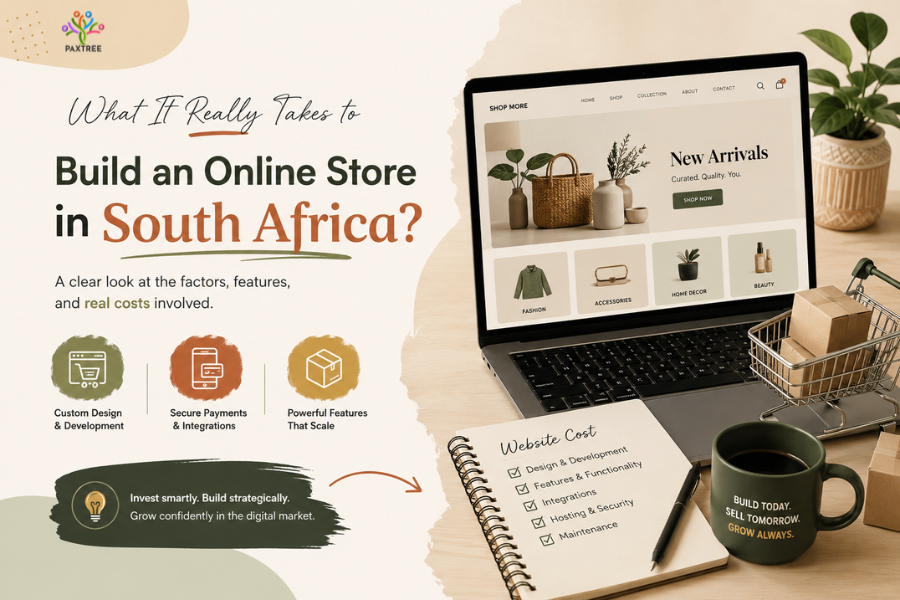
In this guide, we will break down what actually affects e-commerce website pricing, what businesses should expect in 2026, and where most companies usually spend their budget.
Average e-commerce Website Development Cost
In South Africa, a basic e-commerce website normally starts between R8,000 and R25,000.
These websites are usually built for smaller businesses that want a clean online store with product pages, shopping cart functionality, and payment integration.
For growing brands, pricing is often higher.
A professionally developed e-commerce website with custom design, SEO setup, better performance, and advanced functionality can range from R25,000 to R80,000 or more.
Larger e-commerce businesses sometimes invest well over R250,000 when building custom platforms with mobile apps, AI systems, ERP integrations, or multi-vendor functionality.
At first glance, those numbers can feel expensive.
But e-commerce websites are no longer just digital brochures.
For many businesses, the website becomes the primary sales channel.
Why e-commerce Website Prices Vary So Much
A common mistake many business owners make is assuming all e-commerce websites are basically the same.
They are not.
Some websites are created quickly using standard templates with very little customization. Others are carefully designed around customer behavior, conversion optimization, SEO performance, and long-term scalability.
That difference affects pricing heavily.
A template website might look decent initially, but businesses often face limitations later.
The website becomes harder to scale.
The design starts feeling generic.
Performance issues appear.
SEO becomes difficult.
Custom e-commerce development costs more because more planning and technical work goes into the platform.
That may include:
- Custom product filtering
- Better checkout experiences
- Faster website performance
- Advanced integrations
- Personalized customer journeys
- Mobile optimization
For businesses planning long-term growth, those things matter a lot.
Shopify or Custom E-commerce Development?
This is one of the biggest decisions businesses face.
Many South African companies choose Shopify because it is faster to launch and easier to manage.
For startups and medium-sized businesses, Shopify is often a practical option. It supports payment gateways, mobile optimization, inventory management, and marketing integrations without requiring massive development time.
That is why Shopify has become so popular.
But not every business wants the same thing.
As brands grow, many eventually need more flexibility and customization.
That is where custom e-commerce development becomes attractive.
Custom platforms allow businesses to build unique shopping experiences around their products and customers.
Of course, that also increases development costs.
There is no universal answer here.
The right platform depends on the business model, growth plans, and long term goals.
Payment Gateway Integration Matters More Than Most Businesses Think
A lot of e-commerce stores lose potential customers during checkout.
Not because the products are bad.
Because the payment process feels slow, complicated, or untrustworthy.
Customers in South Africa expect secure and smooth online payments. If checkout creates friction, many users abandon their carts within seconds.
That is why payment integration plays such an important role in e-commerce development.
Popular payment gateways include the following:
- PayFast
- Ozow
- Peach Payments
- Yoco
Basic integrations are relatively straightforward.
However, advanced features like subscriptions, recurring billing, split payments, and fraud prevention systems usually require additional development work.
Businesses focused on increasing online sales often spend extra time optimizing the checkout experience because even small improvements can increase conversions.
Mobile Optimization Is Essential
Most e-commerce traffic now comes from mobile devices.
That single shift has changed how e-commerce websites are built.
Customers expect websites to load quickly, fit properly on smaller screens, and make checkout easy.
Unfortunately, many websites still struggle with mobile performance.
Buttons are difficult to tap.
Pages load slowly.
Images break.
Checkout becomes frustrating.
And when that happens, users leave.
A properly optimized mobile e-commerce website should feel smooth from the first click to the final payment.
Mobile optimization also affects SEO.
Google prioritizes mobile-friendly websites in search rankings, which means poor mobile performance can reduce visibility online.
SEO Should Be Part of Development From the Start
Some businesses treat SEO like something they can add later.
That usually creates problems.
A website may look visually impressive, but if the structure is poor, ranking on Google becomes difficult.
SEO works best when it is included during the development stage.
Things like:
- Website speed
- URL structure
- Internal linking
- Product page optimization
- Category hierarchy
- Mobile performance
all influence search visibility.
Businesses that ignore SEO during development often end up depending too heavily on paid advertising later.
That becomes expensive over time.
Strong e-commerce SEO helps businesses generate long-term organic traffic without relying entirely on ads.
AI Is Starting To Influence e-commerce
AI is becoming part of modern e-commerce much faster than many businesses expected.
Even smaller brands are starting to use AI-powered tools for customer support, product recommendations, automation, and marketing.
For example, AI chatbots can answer common customer questions instantly instead of making customers wait for support teams.
Some e-commerce businesses also use automation tools for:
- Order updates
- Customer follow-ups• Cart recovery
- Product recommendations
- Personalized marketing
Not every e-commerce store needs advanced AI systems immediately.
But businesses planning long-term growth are already preparing for it.
Over the next few years, AI will likely become a standard part of e-commerce rather than an optional feature.
Cheap e-commerce development often creates bigger problems later.
This is something many businesses only understand after launch.
Choosing the cheapest e-commerce development option can create expensive problems later.
Poorly built websites often suffer from:
- Slow loading speeds
- Weak SEO foundations
- Security issues
- Broken integrations
- Mobile performance problems
- Limited scalability
Fixing those problems later usually costs far more than building the website properly from the beginning.
That is why businesses should look beyond just the initial development price.
A good e-commerce website should support growth for years, not just help a business launch quickly.
e-commerce Growth in South Africa Continues To Rise
Online shopping continues growing across South Africa.
More customers are using digital payments. Mobile shopping is increasing. Businesses are becoming more comfortable investing in e-commerce.
At the same time, competition is becoming stronger.
Simply having an online store is no longer enough.
Modern e-commerce businesses compete through better customer experience, faster performance, SEO visibility, personalization, and automation.
The brands investing in better digital experiences today are usually the ones building stronger long-term positions in the market.
Final Thoughts
e-commerce website development costs in South Africa vary depending on the size of the business, platform requirements, customization level, and growth goals.
Some businesses only need a clean and professional e-commerce website to begin selling online.
Others need advanced e-commerce ecosystems with AI integrations, automation systems, mobile applications, and custom development.
The important thing is not simply launching a website.
It is building an e-commerce platform that can support long-term business growth.
As e-commerce competition continues increasing in South Africa, businesses investing in performance, user experience, SEO, and scalability will have a much stronger advantage moving forward.
Looking for e-commerce website development services?
At Paxtree, we build modern e-commerce websites designed for growth, performance, and long-term scalability.
Our e-commerce solutions include custom e-commerce development, Shopify development, AI chatbot integration, payment gateway integration, mobile app development, and e-commerce SEO services tailored for South African businesses.
Whether you are launching a new online store or upgrading an existing e-commerce platform, our team can help you create a high-performance digital shopping experience built for results.