AR/VR
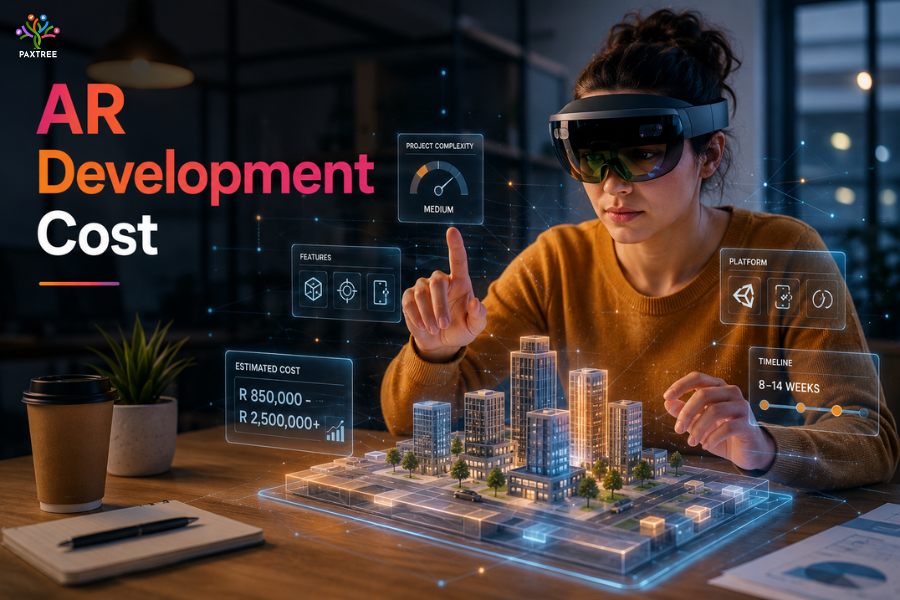
AR development in South Africa can cost anywhere between R45,000 and R2,000,000+, depending on the type of application, custom features, 3D assets, integrations, and overall project complexity. A small AR marketing experience will obviously cost much less than a full enterprise platform with AI-powered interactions and real-time synchronization.
A lot of businesses jump into AR because it looks exciting. But once development actually starts, they realize there is much more involved than placing 3D objects on a screen. Performance optimization, backend systems, animations, cross-platform support, testing, and scalability all affect the final budget.
Over the last few years, South African businesses have started taking augmented reality more seriously. Retail brands are experimenting with virtual try-ons, property companies are creating interactive walkthroughs, and educational platforms are trying immersive learning experiences because users engage with them longer.
That growing demand is also increasing the need for experienced teams that provide professional AR development services instead of basic experimental demos.
AR Is No Longer Just for Gaming
A few years ago, most companies associated AR with gaming apps or social media filters. That idea has changed quickly.
Today, even mid-sized businesses are exploring immersive experiences because customer expectations are different now. People want interactive shopping, visual product previews, and digital experiences that feel more engaging than traditional websites.
Retail is probably one of the biggest examples.
Many online stores in South Africa are investing in AR features that allow customers to preview furniture, glasses, or décor items before purchasing. It reduces uncertainty and usually improves conversions as well.
Real estate companies are also using AR to simplify property presentations. Instead of sending dozens of images, they can offer interactive walkthroughs that help buyers understand spaces more naturally.
The interesting part is that AR adoption is no longer limited to large enterprises. Smaller businesses are slowly entering the space too.
Average AR Development Cost in South Africa
The cost of building an AR application depends heavily on what you are trying to create.
Some projects only require lightweight WebAR functionality for marketing campaigns. Others involve advanced backend systems, multiplayer interaction, AI integrations, and custom 3D environments.
Here is a realistic pricing overview based on common AR projects in South Africa.
| AR Solution Type | Estimated Cost (ZAR) |
|---|---|
| Basic AR Mobile App | R45,000 – R120,000 |
| WebAR Experience | R35,000 – R90,000 |
| AR eCommerce App | R80,000 – R250,000 |
| AR Real Estate Platform | R100,000 – R350,000 |
| AR Education Application | R90,000 – R280,000 |
| AR Gaming Platform | R180,000 – R800,000+ |
| Enterprise AR Solution | R350,000 – R2,000,000+ |
These are not fixed numbers. In reality, project requirements change constantly during development.
One thing many businesses learn late is that adding “small features” repeatedly can increase the budget surprisingly fast. A feature that sounds simple during planning may require backend support, UI adjustments, testing, optimization, and additional development hours behind the scenes.
Cost to Hire AR Developers
If you are planning a serious AR product, hiring experienced developers matters a lot more than many businesses initially think.
Cheap development often becomes expensive later when applications start facing performance issues, unstable architecture, or scaling problems.
In South Africa, AR developer pricing usually depends on technical expertise and project complexity.
| Developer Type | Hourly Cost (ZAR) |
|---|---|
| Junior AR Developer | R250 – R500 |
| Mid Level AR Developer | R500 – R900 |
| Senior AR Developer | R900 – R1,800 |
| Unity AR Developer | R700 – R1,500 |
| AR UI/UX Designer | R400 – R1,000 |
| 3D Artist / Animator | R450 – R1,200 |
Some companies try managing multiple freelancers separately to save money. Sometimes that works for smaller tasks, but larger projects usually become difficult to coordinate without a structured process.
That is one reason businesses often prefer working with an experienced AR development company that handles planning, design, backend systems, testing, and optimization together.
What Actually Makes AR Development Expensive?
The biggest factor is usually complexity.
A simple AR product viewer is very different from an enterprise-level platform with live synchronization, AI-based object recognition, and interactive multiplayer functionality.
Then there is the 3D side of development.
High-quality animations, realistic models, interactive environments, and smooth rendering require skilled design work. Low-quality assets are immediately noticeable in immersive applications, which can damage user experience very quickly.
Platform support also changes pricing.
If you only need Android support initially, the project remains simpler. But if you want Android, iOS, tablets, and WebAR compatibility together, development effort naturally increases.
Another hidden cost many businesses underestimate is backend infrastructure.
Features like analytics dashboards, cloud synchronization, APIs, admin panels, and user management systems require significant development work behind the scenes even though users may never directly notice them.
That is why experienced AR developers usually spend time understanding business goals properly before discussing accurate pricing.
AR Is Expanding Across Multiple Industries
Gaming still gets attention, but it is no longer the center of AR growth.
Retail brands are using immersive shopping experiences because users want more confidence before buying online. Educational platforms are experimenting with interactive learning because engagement rates tend to improve when content feels more visual and practical.
Healthcare organizations are exploring AR simulations for training purposes. Manufacturing companies are using AR interfaces for equipment support and technical guidance.
Even tourism businesses are testing immersive experiences to make attractions more interactive for visitors.
In other words, AR is gradually becoming a practical business tool rather than just a trend.
Why Businesses Prefer Professional AR Development Services
A common mistake businesses make is focusing only on initial development cost.
What usually matters more is long-term stability.
Applications built without proper architecture often become difficult to maintain later. Performance problems, scaling limitations, and poor optimization can eventually cost more than the original development itself.
Professional AR development services generally include planning, testing, optimization, UI/UX improvements, backend architecture, and ongoing support.
That structure becomes important when businesses plan to scale applications over time instead of launching one-time demos.
Businesses looking to hire AR developers usually benefit more from experienced teams that understand scalability from the beginning.
Reducing AR Development Cost Without Ruining the Product
Not every AR application needs advanced features immediately.
One practical approach is launching a smaller MVP first. This helps businesses validate the idea before investing heavily into large-scale development.
Another smart decision is focusing on features that actually improve user experience instead of adding functionality just because competitors are doing it.
Some of the best-performing applications are surprisingly simple.
Cross-platform development can also reduce expenses by avoiding separate development cycles for different operating systems.
Most importantly, proper planning in the early stages usually prevents expensive technical problems later.
Why Businesses Choose Paxtree for AR Development
Paxtree helps startups, growing brands, and enterprises build scalable AR solutions focused on real business goals instead of unnecessary complexity.
Our team works on immersive applications that balance usability, performance, and scalability. From mobile AR apps and WebAR experiences to enterprise platforms and interactive product visualization systems, we focus on building practical solutions that users genuinely engage with.
Businesses looking to hire AR developers often choose Paxtree because long term scalability and performance remain part of the development approach from day one.
Choosing the Right AR Development Company
Price matters, but it should never be the only deciding factor.
A surprisingly large number of projects fail because businesses choose development partners based only on low pricing instead of technical capability.
Before selecting an AR development company, it is important to review previous projects, communication quality, scalability planning, and overall technical expertise.
A strong portfolio usually reveals much more than sales presentations.
Good development teams also ask better questions before starting the project. That usually indicates they are thinking beyond basic execution.
Final Thoughts
AR development in South Africa is growing steadily as businesses search for more engaging digital experiences.
Some projects stay relatively affordable, while others become large-scale investments depending on complexity and business goals. The important thing is building something useful rather than adding features simply because they sound impressive.
Companies planning long-term immersive products should focus on scalability, usability, and performance from the beginning.
If you are looking for experienced AR development services or planning to hire AR developers for a scalable project, Paxtree helps businesses build future-ready AR applications designed for real growth and long-term usability.