AI/ML
Why Most Enterprises Get AI Wrong
Across South Africa, there’s a visible shift toward AI adoption. Enterprises in Johannesburg, Cape Town, and Durban are committing significant budgets to digital transformation with AI. On paper, everything looks aligned. Strong intent, strong investment.
Yet in practice, quite a few of these initiatives never really deliver the outcomes expected.
Here’s what tends to get overlooked.
The issue isn’t AI itself. It’s how organizations approach it.
From what we’ve seen working closely with enterprise teams, there’s often a rush to move. Tools get selected early, vendors come in quickly, and there’s internal pressure to show momentum. It feels like progress. But without a clear AI transformation roadmap, that activity rarely turns into meaningful business results.
Most teams don’t fully anticipate this.
AI without direction becomes experimentation. Expensive experimentation. And the impact doesn’t always show up immediately, which makes it harder to catch early.
At first, it feels manageable. Even promising. Then results don’t follow, and questions start coming in.
If you’re considering AI implementation for enterprises, this is usually the point where it makes sense to slow things down and bring structure into the approach.
What is AI Transformation in Enterprises
AI transformation goes well beyond deploying a chatbot or automating repetitive tasks. Those are incremental improvements. Useful, certainly. Transformational, not quite.
At an enterprise level, transformation shows up in how decisions are made, how processes actually run, and how data is used day to day.
A well-defined enterprise AI strategy typically involves embedding AI into core business functions, enabling better decision-making, and applying enterprise automation solutions to remove inefficiencies that have been sitting there for years.
There’s also a shift that happens quietly. Data stops being something you look at occasionally and becomes something you actively rely on.
Sounds simple enough. It isn’t.
That’s usually where things start getting complicated.
What is an AI Transformation Roadmap?
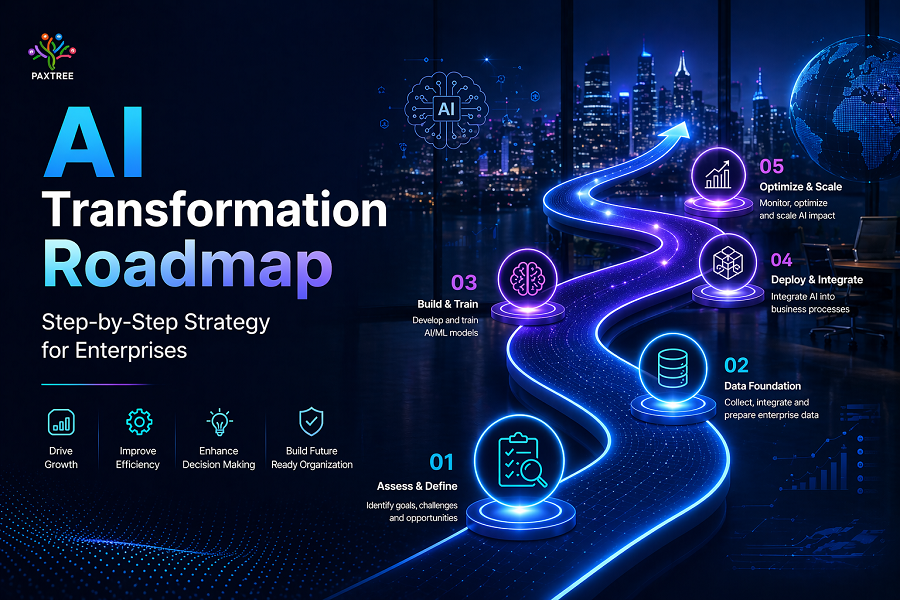
An AI transformation roadmap is essentially a structured plan that helps enterprises move from scattered AI experiments to something more consistent, scalable, and tied to real business outcomes.
It brings together strategy, data, technology, and execution into one direction.
At its core, it answers a practical question: how do we make AI actually work inside the business?
Typically, it covers:
- Clear business objectives aligned with AI initiatives
- Data readiness and infrastructure planning
- Identification of high-impact use cases
- Technology and model selection
- Pilot testing before scaling
- Governance and compliance frameworks
- Continuous optimization processes
On paper, it looks clean. Almost straightforward.
Once you start implementing, though, gaps begin to surface. Small at first, then more noticeable.
In most cases, this is where things start going wrong.
Why AI Adoption Fails in Enterprises
Enterprises don’t usually fail because they lack ambition. If anything, they aim too high too quickly.
They fail because of how they begin.
Across different industries, the same patterns tend to repeat:
- No clearly defined business objective
- Data that isn’t ready or properly structured
- Treating AI as an IT initiative rather than a business priority
- Heavy investment in tools without clarity on use cases
- Limited alignment across teams
One client we worked with in Johannesburg had already invested heavily in AI tools before we got involved. The technology itself wasn’t the issue. The missing piece was direction. There was no clear enterprise AI strategy connecting those tools to actual business outcomes.
Teams usually don’t notice this until later.
From the outside, AI adoption looks straightforward. Internally, it rarely is. Dependencies build up, systems don’t always integrate cleanly, and expectations drift away from what’s realistically achievable.
That’s when things start slipping.
Step-by-Step AI Transformation Roadmap
A step-by-step AI transformation roadmap for enterprises isn’t about moving fast. It’s about sequencing things properly.
Because moving quickly without structure tends to create more issues than it solves.
Step 1: Business Goal Alignment
Everything starts with the business. Not the technology.
When goals are unclear, outcomes tend to reflect that. When goals are specific and tied to real problems, AI begins to show value.
The questions need to be practical. Where is the business losing efficiency? Where are costs increasing? Where are decisions slowing things down?
We worked with a retail group in Cape Town that initially focused on improving customer experience. After a closer look, the real issue turned out to be inaccurate demand forecasting. Fixing that had a direct financial impact.
This step sounds obvious. It often gets rushed.
And when that happens, everything downstream becomes more complicated than it needs to be.
Step 2: Data Readiness and Infrastructure
This is where expectations usually meet reality.
Organizations often assume their data is ready. Most of the time, it isn’t.
Data sits across systems, formats don’t align, and integration is inconsistent. Fixing this takes time.
In one Durban-based logistics company, operational data was spread across several disconnected systems. Before any AI model could even be considered, we had to bring that data together and clean it.
That alone took longer than expected.
In many cases, data preparation stretches timelines. It slows things down, but it’s necessary.
On paper it works. In execution, it often doesn’t—at least not without this step.
Step 3: AI Use Case Identification
Not every problem needs AI. That’s something many teams realize after trying to do too much.
The focus should be on use cases where impact is clear and measurable.
Typical starting points include the following:
- Demand forecasting
- Fraud detection
- Customer churn prediction
- Process automation
There’s often a tendency to overcomplicate this stage. Teams try to tackle multiple problems at once.
If you’re working with AI consulting services South Africa, this is where experienced guidance makes a noticeable difference.
Starting with one well-defined use case tends to be far more effective.
Step 4: Technology and Model Selection
There’s a common assumption that more advanced technology leads to better results.
In practice, it often introduces more complexity than value.
You don’t always need to build custom models from scratch. Many AI solutions for businesses already exist and can be implemented effectively.
The decision should be based on what’s required, not what’s technically possible.
For example, highly regulated sectors may require more control and customization. Others can move faster using existing platforms.
The goal isn’t sophistication. It’s reliability.
Step 5: Pilot Project (Proof of Concept)
Skipping this step usually creates problems later.
A pilot allows you to test assumptions, measure real impact, and understand what needs adjustment before scaling.
We worked with a manufacturing company in Johannesburg that implemented predictive maintenance on a single production line. The improvements were clear.
That initial success helped build confidence.
Not immediately, but enough to move forward.
Pilots reduce risk. They also help align teams internally, which becomes important as things scale.
Step 6: Scaling AI Across the Organization
Scaling is where many initiatives struggle.
It’s often assumed that once a pilot works, scaling will follow naturally. It doesn’t.
At this stage, the focus shifts. Less about technology, more about people and processes.
Systems need to integrate properly. Processes need to align. Teams need to understand how to use what’s been built.
Adoption becomes the deciding factor.
Without it, even well-designed enterprise automation solutions won’t deliver the expected value.
Step 7: Governance, Ethics, and Compliance
AI introduces additional risk layers. Ignoring them isn’t an option.
In South Africa, compliance with POPIA is a baseline requirement. Beyond that, organizations need to think about data security, model transparency, and potential bias.
Governance frameworks provide structure around these concerns.
They’re often not prioritized early on. But they become important quickly.
Step 8: Continuous Optimization
AI doesn’t end at deployment.
Models need monitoring. Data changes. Business conditions shift.
Organizations that treat AI as an ongoing capability tend to perform better over time.
It doesn’t feel significant at first. But over time, the impact becomes clear.
Consistency here is what drives long-term value.
Enterprise AI Use Cases (Industry-wise)
AI is already being applied across multiple sectors in South Africa.
Financial institutions in Johannesburg are using it for fraud detection and risk assessment. Retail companies in Cape Town are improving forecasting and personalization. Logistics firms in Durban are optimizing operations and reducing costs.
Healthcare is also starting to see practical applications.
If you’re exploring broader enterprise AI solutions, this is typically where things begin to take shape in a real operational context.
These are no longer experimental use cases. They’re becoming part of standard operations.
Benefits of AI Transformation
When implemented properly, AI delivers clear advantages.
Operations become more efficient. Decisions improve. Costs gradually decrease. New opportunities start to emerge.
But none of this comes from tools alone.
Execution is what makes it work.
Digital transformation with AI only delivers results when it’s aligned with business priorities. Without that alignment, results tend to fall short.
Common Mistakes to Avoid
Even with a structured roadmap, certain mistakes come up repeatedly.
Treating AI purely as an IT project is one. Ignoring data quality is another. Scaling too early, overengineering solutions, and overlooking adoption all create friction.
We’ve seen these patterns play out many times.
Avoiding them doesn’t guarantee success. But it removes a lot of unnecessary complexity.
Cost of AI Implementation in South Africa
Cost is always part of the conversation.
The cost of AI implementation in enterprises varies depending on scope, complexity, and how prepared the organization is from a data perspective.
Typical ranges:
- Pilot projects: R350,000 – R1,800,000
- Full AI transformation: R3,500,000 – R18,000,000+
Costs vary significantly depending on data maturity and scope.
What often gets overlooked is the cost of doing nothing.
Inefficiencies continue. Opportunities are missed. It’s less visible, but over time, it adds up.
Why Choose an AI Partner in South Africa
Choosing the right partner has a direct impact on outcomes.
An experienced AI development company in South Africa brings technical expertise along with an understanding of local regulations and business realities.
Whether you’re exploring AI consulting in Johannesburg, AI services in Cape Town, or working with an AI company in Durban, alignment matters.
The right partner doesn’t just build systems. They help shape decisions and stay involved as things evolve.
That’s where real value tends to come from.
Final Thoughts
AI isn’t something you install and move on from. It’s something you build over time.
Organizations that succeed take a structured approach. They align AI with business priorities and execute consistently.
It may not look impressive at first. But over time, it delivers.
And that’s what separates successful AI implementation for enterprises from everything else.
Ready to Start Your AI Journey
If your AI initiative still lacks clarity, it’s worth addressing that now rather than continuing with uncertainty.
If you’re exploring an AI transformation roadmap or refining your enterprise AI strategy, the next step is understanding where you stand and what needs to happen next.
- Book a free AI consultation
- Talk to our AI experts today
- Get a tailored AI roadmap for your business
- Hire AI Developers
FAQS
What is an AI transformation roadmap for enterprises?
An AI transformation roadmap is a structured approach that helps enterprises move from isolated AI experiments to scalable, business-driven outcomes. It aligns strategy, data, technology, and execution so AI initiatives deliver measurable impact instead of fragmented results.
Why do most AI projects fail in enterprises?
Most AI projects fail due to unclear business objectives, poor data readiness, and lack of alignment across teams. Many organizations invest in tools before defining use cases, which leads to expensive experimentation without real outcomes.
How long does enterprise AI transformation take?
Timelines vary depending on scope and data maturity. Typically, pilot projects take 3–6 months, while full AI transformation across an enterprise can take 12–24 months with continuous optimization.
What are the first steps in AI implementation for enterprises?
The first step is aligning AI initiatives with clear business goals. After that, organizations need to assess data readiness, identify high-impact use cases, and validate ideas through pilot projects before scaling.
How much does AI implementation cost in South Africa?
AI implementation costs depend on complexity and readiness. Pilot projects usually range from R350,000 to R1,800,000, while full-scale enterprise AI transformation can range from R3,500,000 to R18,000,000+.
Should enterprises work with an AI consulting partner?
Yes, in most cases. An experienced AI consulting partner helps define strategy, identify the right use cases, avoid costly mistakes, and ensure long-term success beyond initial implementation.