Mobile App Development
South Africa’s transportation industry is evolving rapidly, and mobile technology is playing a major role in that transformation. Consumers no longer want to wait on the roadside or make multiple phone calls to book a ride. They expect a simple mobile experience that lets them request a driver, track the vehicle in real time, make secure digital payments, and reach their destination with confidence. This shift has created a significant opportunity for entrepreneurs, transport operators, and investors who want to launch their own ride-hailing platform.
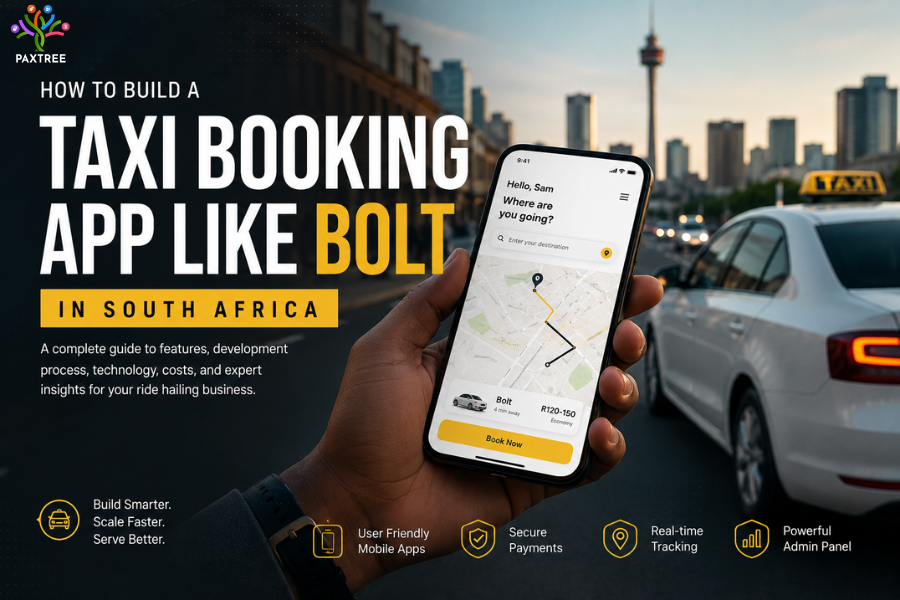
If you’re planning to build a taxi booking app like Bolt in South Africa, success depends on much more than developing a mobile application. You need a clear business strategy, reliable technology, an intuitive user experience, and a platform that can grow with your business. Working with an experienced taxi booking app development company helps ensure your application is built to meet customer expectations while remaining secure, scalable, and future-ready.
Whether your goal is to serve one city or expand across the country, a well-designed taxi booking platform can become a valuable digital asset that generates recurring revenue and builds long-term customer loyalty.
Why Ride-Hailing Apps Continue to Grow in South Africa
Over the last few years, South Africans have embraced mobile technology for everyday services, from banking and shopping to food delivery and healthcare. Transportation is no different. People want faster, safer, and more convenient ways to travel, while businesses are looking for smarter ways to manage drivers, bookings, and payments.
This growing demand has encouraged many startups and transport companies to invest in custom ride hailing platforms instead of relying on traditional booking systems.
Cities such as Johannesburg, Cape Town, Durban, Pretoria, and Gqeberha have experienced significant growth in app-based transportation services. These urban centers have large populations, busy commercial districts, and increasing smartphone adoption, making them ideal markets for digital mobility solutions.
For business owners, this creates an opportunity to offer reliable transportation while improving operational efficiency. Instead of manually assigning drivers or handling bookings over the phone, a mobile platform automates the entire process, saving time for both passengers and drivers.
Understanding How a Taxi Booking App Works
At its core, a taxi booking app connects passengers with nearby drivers through GPS technology. While the concept seems straightforward, several systems work together behind the scenes to create a smooth booking experience.
A customer opens the application, enters a pickup point and destination, and receives an estimated fare before confirming the trip. The platform then identifies the nearest available driver, sends a ride request, and provides live tracking until the journey is complete. Once the trip ends, payment is processed automatically, and both the passenger and driver can rate their experience.
Although this process takes only a few minutes from the user’s perspective, it depends on sophisticated technologies such as location tracking, cloud computing, secure payment processing, and real-time communication.
Because every interaction happens digitally, businesses gain valuable insights into customer behavior, booking trends, and driver performance, making it easier to improve services over time.
Why Custom Development Is Better Than a Ready-Made Solution
Many entrepreneurs begin their research by looking for ready-made taxi booking software or white-label applications. While these options may seem attractive because of their lower upfront cost, they often become restrictive as the business grows.
A custom developed application is designed specifically for your business model, allowing you to create a unique customer experience and adapt quickly to market demands.
Imagine launching a transportation service focused on airport transfers in Johannesburg. As demand grows, you may decide to introduce premium vehicles, corporate travel accounts, or shuttle services for hotels. A custom platform makes these changes possible without forcing you to rebuild your application from scratch.
This flexibility is one of the biggest reasons businesses choose custom mobile app development over generic software.
Custom development also gives you complete ownership of your platform. You control the branding, pricing structure, commission model, user experience, and future feature development without depending on the limitations of third-party software providers.
The Three Core Components of Every Taxi Booking Platform
A successful ride-hailing application is much more than a passenger app. Behind every completed booking are three connected systems that work together to manage the entire transportation process.
Passenger Application
The passenger application is the public face of your business. It should make booking a ride feel effortless, even for first-time users.
Customers expect an experience that is quick, intuitive, and reliable. From registration to payment, every interaction should be designed to reduce friction and build confidence.
Instead of overwhelming users with unnecessary features, focus on providing the essentials. These include account creation, ride booking, live driver tracking, secure payments, trip history, and customer support. When these core functions work seamlessly, customers are far more likely to return.
A positive first impression often determines whether someone becomes a loyal customer or downloads a competitor’s app.
Driver Application
Drivers are the backbone of every ride hailing business, which means their application should be designed to maximise productivity rather than create additional work.
Once approved by the platform administrator, drivers should be able to receive ride requests instantly, navigate efficiently using integrated maps, manage their availability, and monitor their daily earnings from a single dashboard.
An effective driver app reduces idle time, shortens pickup delays, and helps drivers complete more trips throughout the day. This not only improves driver satisfaction but also increases revenue for the business.
Providing transparent earnings reports and performance insights can further strengthen driver retention, which is essential in a competitive transportation market.
Admin Dashboard
While passengers and drivers interact with the mobile application, business owners rely on the admin dashboard to manage daily operations.
This dashboard acts as the control center of the entire platform, allowing administrators to monitor bookings, approve new drivers, resolve customer issues, manage promotions, and analyze business performance.
Rather than manually tracking hundreds or thousands of daily trips, the dashboard provides real-time reporting on revenue, active users, completed journeys, and operational trends.
These insights help business owners make informed decisions about pricing, marketing campaigns, driver incentives, and future expansion.
Features That Make Users Choose Your App
One of the biggest mistakes businesses make is trying to copy every feature available in existing ride-hailing platforms. Instead of focusing on quantity, concentrate on features that genuinely improve the customer experience.
Passengers value simplicity. They want to open the app, book a ride within seconds, see exactly where the driver is, pay securely, and reach their destination without unnecessary complications.
Drivers, on the other hand, want tools that help them earn more efficiently. Features such as intelligent ride allocation, integrated navigation, earnings summaries, and flexible availability settings allow drivers to spend less time waiting and more time completing trips.
Business owners benefit from automation. Real-time analytics, driver management, booking reports, commission settings, promotional campaigns, and customer support tools all contribute to a more efficient operation while reducing manual administrative work.
The most successful taxi booking platforms are not necessarily the ones with the longest feature list. They are the ones that solve everyday transportation problems in the simplest and most reliable way.
Why User Experience Is More Important Than Features
Many startups assume that adding more features automatically creates a better application. In reality, the opposite is often true.
Customers are more likely to continue using an app that feels fast, simple, and predictable than one filled with unnecessary options.
Every screen should have a clear purpose. Navigation should feel natural, booking should require as few steps as possible, and important actions such as contacting a driver or cancelling a trip should always be easy to find.
A thoughtfully designed user experience builds trust from the very first interaction. It also reduces support requests, improves customer satisfaction, and encourages repeat bookings.
For businesses entering South Africa’s competitive ride-hailing market, delivering an exceptional user experience can become one of the strongest competitive advantages.
Choosing the Right Technology for Your Taxi Booking App
Technology is the foundation of every successful ride-hailing platform. While users only see the mobile application, there is an entire ecosystem working behind the scenes to manage bookings, calculate fares, process payments, assign drivers, and deliver real-time updates.
Choosing the right technology stack is not about following trends. It is about selecting tools that support your business today while giving you the flexibility to grow tomorrow. A platform serving a few hundred users in Johannesburg has very different requirements from one operating across multiple cities with thousands of daily rides.
An experienced taxi booking app development company evaluates your business model before recommending technologies. This approach helps avoid unnecessary development costs while ensuring the platform remains stable as user demand increases.
Native or Cross-Platform Development
One of the first technical decisions involves choosing how your application will be developed.
Native development means creating separate applications for Android and iOS. This approach delivers the highest level of performance because each app is built specifically for its operating system. Features such as GPS, camera access, push notifications, and biometric authentication integrate seamlessly, making native development an excellent choice for businesses planning large-scale operations.
Cross-platform development offers another practical option. Frameworks like Flutter and React Native allow developers to build applications for both Android and iOS using a shared codebase. This significantly reduces development time while maintaining a consistent user experience across devices.
For many startups entering the South African market, cross-platform development provides the ideal balance between speed, quality, and cost efficiency. As the business grows, the application can continue evolving without requiring a complete rebuild.
Building a Reliable Backend
Every ride request, payment confirmation, driver assignment, and customer notification passes through the backend before appearing inside the mobile application. If the backend is slow or unreliable, even the most attractive app will struggle to deliver a smooth experience.
Modern backend technologies such as Node.js, Laravel, Python, and .NET are commonly used because they support secure APIs, real-time communication, and high-performance cloud environments. More importantly, they allow the platform to manage increasing numbers of passengers and drivers without compromising speed or reliability.
The backend also stores trip history, customer accounts, driver information, and financial records, making security and performance equally important considerations during development.
Cloud Infrastructure Supports Business Growth
A taxi booking platform should never struggle because more people are using it. This is where cloud infrastructure becomes essential.
Cloud platforms such as Amazon Web Services (AWS), Microsoft Azure, and Google Cloud Platform automatically allocate additional resources during busy periods. Whether your platform experiences increased demand during rush hour or expands into new cities, cloud hosting helps maintain fast response times and reliable performance.
Cloud infrastructure also improves business continuity through automated backups, disaster recovery, secure data storage, and continuous monitoring. Instead of investing in expensive physical servers, businesses benefit from flexible resources that grow alongside their customer base.
Maps and GPS Integration
Location technology is at the heart of every ride-hailing platform. Without accurate GPS services, passengers cannot track drivers, and drivers cannot efficiently navigate to pickup locations.
Integrating mapping solutions such as Google Maps or Mapbox enables real-time tracking, route optimization, distance calculations, and estimated arrival times. These capabilities improve customer confidence while helping drivers complete more journeys throughout the day.
Reliable location services also allow businesses to introduce features such as favorite pickup locations, route history, and geofencing for airports, shopping centers, or business districts.
Secure Payment Integration
Passengers expect flexibility when paying for transportation. Some prefer credit or debit cards, while others use digital wallets, instant EFT, or cash.
Supporting multiple payment methods creates a better customer experience and reduces abandoned bookings. In South Africa, payment providers such as PayFast, Ozow, Peach Payments, and Stripe can be integrated to offer secure and convenient transactions.
Beyond convenience, payment security is essential. Encryption, fraud detection, and secure authentication help protect customer information while building trust in your platform.
Step-by-Step Process for Building a Taxi Booking App
Developing a successful mobility platform is a structured process that combines business planning, design, development, testing, and continuous improvement. Skipping any of these stages often leads to unnecessary costs and delays later in the project.
Start with market validation.
Before development begins, spend time understanding your target audience and competitors. Every city has different transportation challenges, customer expectations, and pricing models.
Research questions such as:
- Which areas have the highest demand?
- What problems do existing ride hailing services fail to solve?
- Which customer segments will you target first?
- How will your platform stand out?
The answers will influence every decision that follows, from feature selection to pricing strategy.
Define the Minimum Viable Product
Many startups attempt to launch with every possible feature, which often increases costs without adding immediate value.
A smarter approach is to develop a minimum viable product (MVP). This version includes the essential functionality required to begin serving customers while allowing room for future improvements based on real user feedback.
Launching an MVP helps validate your business model faster and reduces financial risk during the early stages of growth.
Focus on User Experience
Design is not simply about colours and icons. It determines how easily passengers can book rides and how efficiently drivers can complete them.
Every interaction should feel intuitive. Booking a ride, tracking a driver, making a payment, or contacting support should require as few steps as possible. A clean interface encourages repeat usage and strengthens customer loyalty.
Investing in thoughtful UI and UX design often delivers a greater return than adding unnecessary features.
Development and Integration
Once planning and design are complete, developers begin building the passenger application, driver application, backend services, and administrative dashboard.
During this phase, the platform is integrated with third party services such as mapping providers, payment gateways, SMS notifications, and analytics tools. These integrations ensure the application can deliver the real time functionality users expect from a modern ride hailing platform.
Rather than waiting until the end of the project, experienced development teams test features continuously throughout this stage. This approach helps identify issues early, reducing costly revisions before launch.
Testing Before Launch
Launching without proper testing can damage customer trust from the very beginning.
Quality assurance should include functional testing, performance testing, security testing, and compatibility testing across different devices and operating systems. GPS accuracy, payment processing, and notification delivery should also be thoroughly verified before the application reaches users.
A stable first release creates confidence among both passengers and drivers, making future growth much easier.
How Much Does It Cost to Build a Taxi Booking App in South Africa?
One of the first questions entrepreneurs ask is how much they should budget for development. The answer depends on the scope of the project rather than a single fixed price.
An application built for a local startup will naturally require a different level of investment than an enterprise platform designed to operate across multiple cities.
The table below provides a general comparison of typical development ranges.
| Solution | Estimated Cost (ZAR) | Best Suited For |
| MVP Taxi Booking App | R150,000 to R300,000 | Startups validating a new idea |
| Standard Ride Hailing Platform | R300,000 to R700,000 | Growing transportation businesses |
| Enterprise Mobility Platform | R700,000 to R1,500,000+ | Multicity operations and large organisations |
While cost is an important consideration, long-term value should be the primary focus. A reliable platform that scales with your business often delivers a significantly higher return on investment than a cheaper solution that requires major redevelopment after a short period.
Several factors influence development costs, including application complexity, design quality, supported platforms, third-party integrations, security requirements, cloud infrastructure, and ongoing maintenance.
Choosing Between Native and Cross-Platform Development
Businesses frequently ask whether native development or cross-platform development is the better choice. The answer depends on your objectives.
| Comparison | Native Development | Cross-Platform Development |
| Performance | Excellent | Very Good |
| Development Time | Longer | Faster |
| Initial Investment | Higher | Lower |
| User Experience | Platform-specific | Consistent across devices |
| Maintenance | Separate codebases | Shared codebase |
| Best Choice For | Large-scale platforms | Startups and growing businesses |
Neither approach is universally better. The right decision depends on your budget, timeline, and long-term expansion plans.
Building a Sustainable Revenue Model
Developing the application is only part of the business journey. Long term success depends on generating consistent revenue while delivering value to both passengers and drivers.
Most ride hailing businesses begin with a commission based model, earning a percentage from every completed trip. As the platform grows, additional revenue opportunities become available.
Many successful platforms introduce subscription plans for drivers, allowing them to access premium benefits or reduced commission rates. Others expand into corporate transportation, airport transfers, courier services, or delivery solutions, creating multiple income streams from the same technology platform.
Some businesses also implement surge pricing during peak demand periods, balancing driver availability while increasing revenue during busy hours.
The strongest mobility businesses rarely rely on a single source of income. Instead, they build a flexible platform capable of supporting new services as customer needs evolve.
Common Challenges When Building a Taxi Booking App
Building a successful ride-hailing platform is about more than launching a mobile application. Many businesses enter the market with a great idea but struggle because they underestimate the operational and technical challenges involved. Understanding these challenges early allows you to build a stronger product and avoid costly mistakes.
Attracting Both Drivers and Passengers
One of the biggest challenges for any new ride-hailing platform is creating a balance between supply and demand. Drivers want enough passengers to earn a consistent income, while passengers expect quick pickup times. Without one group, it becomes difficult to attract the other.
Many successful startups overcome this challenge by launching in a specific city or region before expanding nationally. They also introduce referral programs. promotional offers, and driver incentives to build momentum during the early stages.
Delivering a Consistent User Experience
Customers compare every new transportation app with established platforms. If booking a ride feels slow or confusing, users are unlikely to return.
A clean interface, fast loading times, accurate GPS tracking, and transparent pricing create confidence from the first interaction. Regular updates based on customer feedback also help improve retention and encourage positive reviews.
Protecting User Data
Passengers trust your platform with personal details, payment information, and location data. That trust must be protected.
Security should be built into every stage of development rather than added later. Secure authentication, encrypted communication, protected payment processing, and regular security audits help safeguard customer information while reducing business risk.
Planning for Growth
Many applications perform well during launch but struggle as the number of users increases. Slow performance, delayed notifications, or unreliable GPS tracking can quickly damage customer confidence.
Building on a scalable cloud infrastructure allows the platform to support growing demand without affecting the overall user experience. Planning for future growth from the beginning is far more cost-effective than rebuilding the platform later.
How to Choose the Right Development Partner
Selecting the right development company can have a significant impact on the success of your project. Beyond technical skills, you need a partner who understands your business goals and can recommend solutions that create long term value.
When comparing potential development companies, start by reviewing their portfolio. Previous experience with on-demand applications, mobility platforms, or logistics solutions often indicates a deeper understanding of the challenges involved.
Communication is equally important. A reliable partner should explain technical decisions in clear language, provide realistic timelines, and keep you informed throughout the project. Transparency during development reduces misunderstandings and helps projects stay on schedule.
It is also worth asking about post-launch support. Mobile applications require ongoing maintenance, security updates, and compatibility improvements as Android and iOS continue to evolve. Working with a company that offers long-term support ensures your application continues performing well after launch.
Future Trends Shaping Ride-Hailing in South Africa
The transportation industry continues to evolve as new technologies create better experiences for passengers and drivers. Businesses investing in a custom platform today should also consider how these innovations may influence future growth.
Artificial intelligence is expected to play a larger role in ride hailing over the coming years. Intelligent algorithms can improve driver allocation, predict demand during busy periods, and recommend the most efficient routes based on real time traffic conditions.
Electric vehicles are also becoming more common, creating opportunities for platforms to introduce charging station information, battery monitoring, and environmentally friendly ride options. As sustainability becomes increasingly important, businesses that support greener transportation may gain a competitive advantage.
Another growing trend is the expansion of mobility platforms beyond traditional taxi services. Many companies now combine ride hailing with courier delivery, food delivery, vehicle rentals, and corporate transportation. Offering multiple services through a single application increases customer engagement while creating additional revenue streams.
Voice assistants, predictive analytics, and personalized customer experiences are also expected to become more common, helping businesses deliver faster and more convenient transportation services.
Why Choose Paxtree for Taxi Booking App Development?
Building a successful ride-hailing platform requires more than technical expertise. It requires a development partner who understands how technology supports business growth.
At Paxtree, we develop custom taxi booking applications designed around your unique business objectives rather than relying on one-size-fits-all solutions. Our team works closely with startups, transport companies, and established enterprises to create applications that are secure, scalable, and easy to use.
From the initial discovery workshop through design, development, testing, deployment, and ongoing support, every stage of the project focuses on delivering measurable business value.
Our development approach combines modern technologies with practical industry knowledge, allowing businesses to launch platforms that improve customer experiences while simplifying day-to-day operations.
Whether you are building a local transportation service or planning to expand across South Africa, we help you create a platform that is ready for long-term growth.
Conclusion
The demand for digital transportation services continues to grow across South Africa, creating exciting opportunities for entrepreneurs and businesses looking to enter the ride-hailing industry. Building a taxi booking app like Bolt is no longer just about creating a mobile application. It requires a clear business strategy, the right technology, an exceptional user experience, and a platform that can scale as demand increases.
Businesses that invest in a custom solution gain greater flexibility, stronger security, and the ability to adapt as customer expectations evolve. From intelligent driver management to secure payment processing and real-time GPS tracking, every component contributes to a reliable and competitive transportation platform.
Whether you’re launching your first mobility startup or expanding an existing transport business, partnering with an experienced taxi booking app development company can make the development journey more efficient and significantly improve your chances of long-term success.
Ready to Build Your Ride-Hailing Platform?
If you’re planning to build a taxi booking app like Bolt in South Africa, now is the ideal time to turn your idea into reality. A professionally developed platform can help you streamline operations, improve customer satisfaction, and create new revenue opportunities in one of the country’s fastest-growing digital markets.
Paxtree specializes in custom mobile app development for startups and enterprises across South Africa. Our team combines technical expertise with business insight to build secure, scalable, and high-performing ride-hailing solutions tailored to your goals.
Contact Paxtree today to discuss your project and discover how we can help you build a taxi booking platform that is ready for the future.