Home > Blog
Most people underestimate how far along this actually is.
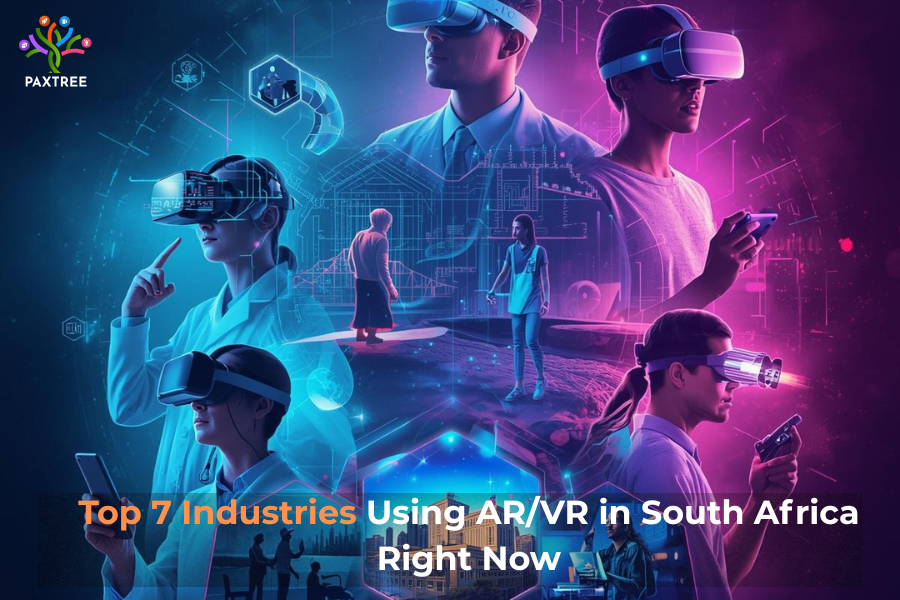
There is a persistent assumption that AR and VR – augmented reality and virtual reality – are still somewhere in the “coming soon” category for South African businesses. Walk through what is actually being built and deployed right now in Johannesburg, Cape Town, and Durban, and that assumption falls apart quickly. Augmented reality in South Africa and virtual reality across seven key industries are being used not as pilot experiments but as working tools that solve specific, costly problems.
We build some of those tools at Paxtree. And from where we sit, the AR/VR adoption curve in South Africa is steeper than most industry reports suggest. The augmented reality South Africa market was sitting around USD 183 million in 2022 and is forecast to reach USD 483 million by 2029 – growing at roughly 17.5% per year. South Africa’s 4IR strategy has accelerated enterprise investment in immersive technology significantly, and the results are showing up on the ground.
Here are the seven industries where AR and VR in South Africa are actually making a difference right now.
Paxtree delivers cutting-edge augmented and virtual reality development tailored for South African industries – from mining and healthcare to real estate and retail.
Fixing a Skills Shortage with a Headset
South Africa has a well-documented shortage of specialist healthcare workers, particularly outside Gauteng and the Western Cape. Getting a neurosurgeon to Limpopo is hard. Getting a VR healthcare simulation of a neurological procedure to a training facility in Polokwane is considerably easier – and that is roughly the logic driving augmented reality and virtual reality adoption in South Africa’s healthcare sector right now.
Medical schools linked to Wits, UCT, and Stellenbosch have started integrating simulation-based VR training for students covering surgical procedures, trauma response, and ICU emergencies – scenarios that are genuinely difficult to recreate safely in a classroom. On the clinical side, AR systems that project patient data or anatomical overlays directly into a surgeon’s field of vision are being trialled, reducing time spent looking away from the patient.
Mental health practitioners are taking VR more seriously too. Exposure therapy for phobias, PTSD, and anxiety using virtual environments has solid research backing, and South African psychologists are bringing it into practice rather than just academic settings.
| Paxtree builds custom healthcare apps for South African clinics, hospitals, and medtech startups – including platforms with AR and VR integration. See our Healthcare App Development services. |
Paxtree specialises in healthcare app development for South African clinics, hospitals & medtech startups.
Where the ROI Is Clearest
If you want to find the most commercially serious use of AR and VR in South Africa, AR mining applications are where to start. The business case is not complicated: underground mining is genuinely dangerous, training workers properly is expensive, and any technology that reduces injuries and speeds up onboarding has obvious financial value. South Africa’s 4IR roadmap specifically identifies AR and VR in mining as a national priority – and the sector has responded.
Major operations across the Witwatersrand, the Bushveld Igneous Complex, and Mpumalanga are using VR-based safety inductions covering hazard recognition, emergency evacuation, and equipment operation. These used to take several days. With immersive VR training in South Africa’s mining sector, they take a fraction of the time – and retention rates are measurably better. People remember what they have experienced more than what they have read.
AR mining tools play a different role on the surface: technicians wear smart glasses that overlay repair instructions, schematics, or live diagnostic data onto physical machinery. This is particularly valuable when the person doing the repair is not the senior engineer – they effectively get expert guidance overlaid on what they are actually looking at, in real time.
Making the Abstract Concrete
South Africa’s education system has persistent, structural problems – unequal resource distribution being the most obvious. A learner at a well-funded school in Sandton has access to laboratory equipment, specialist teachers, and updated materials that a learner in a rural Eastern Cape school simply does not have. AR and VR in South Africa’s education sector cannot fix that inequality entirely, but they close part of the gap in ways that matter practically.
Smartphone-based AR is being used in schools across Johannesburg, Pretoria, and Durban to make Life Sciences and Physical Science tangible. Instead of reading about the cardiovascular system, learners interact with a 3D model of it. At the TVET and university of technology level, VR education labs are being used for engineering, automotive, and electrical training – VR South Africa educators say the technology makes dangerous scenarios safe to simulate and expensive equipment accessible to more learners. South Africa’s 4IR agenda has pushed more schools and institutions to prioritise XR technology adoption through dedicated government funding streams.
Corporate VR training in South Africa is growing fast too. Financial services companies and large manufacturers are using immersive technology for onboarding and compliance because the cost-per-outcome is better than classroom alternatives.
Whether you’re in healthcare, mining, retail, or education – Paxtree has built immersive AR/VR solutions for South African businesses just like yours.
Selling Properties That Don’t Exist Yet
Anyone who has tried to sell a property off-plan knows the core problem: you are asking someone to commit significant money to something that is not built yet. Floor plans and brochures only go so far. VR changes that equation substantially – and it is one of the areas where we have direct experience at Paxtree.
Beyond our own work, the broader trend is clear. Property developers and estate agents in Sandton, the Atlantic Seaboard, Umhlanga Ridge, and the Stellenbosch Wine Country are using VR walkthroughs as a standard sales tool now. A buyer in Durban can walk through an apartment in a Cape Town development that has not broken ground. An international investor can inspect a Clifton property from London without a flight.
Architects and interior designers are using AR to show clients proposed changes in their actual existing space using a tablet or phone. It cuts revision cycles significantly and speeds up sign-off – which matters when project timelines are tight.
| Paxtree develops real estate apps for South African property developers and agencies – from AR visualisation platforms to virtual tour tools. See our Real Estate App Development services. |
From virtual property tours to AR staging – Paxtree builds real estate apps that close deals faster.
Exporting South Africa Without a Plane Ticket
South Africa has extraordinary tourism assets – and a persistent challenge getting people to them. Distance, cost, and perception are all factors. Augmented reality in South Africa’s tourism sector and VR previews give the country a way to let people experience those assets digitally first, which research consistently shows improves actual booking conversion rates.
On the heritage side, sites like Robben Island and the Cradle of Humankind are natural fits for AR-enhanced visitor experiences. Walking through Robben Island with an AR app running a historically accurate reenactment tied to your physical location is genuinely different from reading a placard. At Maropeng, VR reconstructions of the prehistoric landscape give younger visitors a context that static exhibits struggle to provide.
Travel operators have started producing VR preview content specifically for international marketing – 360-degree safari footage, Garden Route fly-throughs, Cape Winelands immersive previews used at trade shows in Europe and distributed digitally to potential travellers in Asia.
The Problem with Buying Online
The biggest friction point in online retail is uncertainty – will this sofa fit? Will this colour suit me? Will these shoes be the right size? Returns are expensive for retailers and frustrating for customers. AR retail technology in South Africa addresses that friction directly, and local adoption is picking up pace.
South African retailers, from established chains to growing e-commerce platforms, are investing in AR-powered try-before-you-buy features. AR retail apps let shoppers in South Africa test fashion and beauty products through their phone camera, preview furniture in their actual room, and interact with FMCG packaging that triggers digital content when scanned. The practical result: fewer returns, higher basket sizes, and stronger brand recall.
| Paxtree builds retail and e-commerce apps for South African brands, including AR product preview and virtual try-on features. See our Retail & E-Commerce App Development services. |
Virtual try-ons, AR product previews & immersive shopping – Paxtree delivers e-commerce apps that convert.
Reducing Rework Before It Happens
In construction and manufacturing, mistakes are expensive. A design conflict found in a VR walkthrough before breaking ground costs nothing to fix. The same conflict found during the build can cost hundreds of thousands of rands and weeks of delays. That is the core value proposition driving augmented reality and virtual reality adoption across South Africa’s built environment – and why AR/VR South Africa investment in this sector is climbing year on year.
On factory floors – particularly in automotive and electronics manufacturing in Ekurhuleni and the wider Gauteng industrial corridor – AR-guided assembly is becoming more common. Workers follow step-by-step instructions overlaid directly onto physical components, reducing training time and error rates. In construction, Building Information Modelling (BIM) combined with VR lets project managers, clients, and contractors identify spatial clashes in a shared virtual model before any physical work begins.
Paxtree has also worked at the intersection of immersive technology and engagement – and one of those projects is worth mentioning in the context of how VR is being used beyond strict industrial training.
| Metric | Value | Source |
| Market value (2022) | USD 183.82 million | BlueWeave Consulting |
| Projected value (2029) | USD 483.15 million | BlueWeave Consulting |
| CAGR (2023–2029) | 17.48% | BlueWeave Consulting |
| Largest segment | AR Software | Statista |
| Largest end-user | Enterprise sector | Spherical Insights |
| Top adoption sectors | Mining, Education, Healthcare | Regional market data |
What is the difference between AR and VR?
Augmented reality (AR) adds digital layers on top of the real world – you see information, models, or animations sitting in your actual environment through your phone or smart glasses. Virtual reality (VR) replaces your environment entirely with a computer-generated one, accessed through a headset. Extended reality (XR) is the umbrella term covering both. All three are in active commercial use in South Africa, often for different purposes within the same industry.
Which industries have gone furthest with this in South Africa?
AR mining in South Africa has arguably the most mature, commercially serious deployment – driven by a clear safety and training ROI. VR healthcare South Africa adoption is close behind, particularly as device costs fall. AR real estate South Africa has accelerated sharply post-pandemic. Retail and education are catching up fast, with 4IR South Africa government support pushing investment across all sectors.
Is AR/VR only viable for large companies?
Not anymore. The cost of augmented reality app development in South Africa has dropped significantly. A VR training programme that required a large capital budget a few years ago can now run on mid-range hardware. Several South African XR developers – including Paxtree – offer builds at price points that work for SMEs, not just enterprise clients.
Does Paxtree have experience building AR and VR applications?
Yes. Our portfolio includes ARki 2.0 – an augmented reality real estate visualisation app built for the South African property market – and a Polar Bear immersive VR experience, among other projects. Paxtree’s AR services and VR development work spans multiple industries and client sizes. If you have a project in mind, the best starting point is a conversation.
Where This Is Going
Seven industries. All at different stages. None treating AR or VR as a gimmick.
What stands out about augmented reality and virtual reality adoption in South Africa is that it has been driven by specific, practical problems – a shortage of specialist doctors, the cost and danger of underground training, the friction in remote property sales – and XR technology turning out to be genuinely useful answers. That produces more durable adoption than hype cycles.
South Africa’s 4IR agenda has given both public and private sector organisations a framework to justify immersive technology investment. AR mining South Africa, VR healthcare South Africa, AR retail South Africa – these are no longer niche experiments. They are line items in operational budgets.
From our side at Paxtree, the enquiries we get have shifted noticeably. A year ago, most conversations started with ‘we are exploring whether this makes sense for us.’ Now, they start with ‘we know we need this – how do we build it well?’ That shift matters.
The extended reality market forecast to nearly half a billion US dollars by 2029 reflects that underlying commercial logic. South Africa is not just consuming this technology – there is a local AR/VR development ecosystem building solutions specifically for the South African context, and that is a more encouraging story than simply importing tools designed elsewhere.
For businesses in any of the seven sectors covered here, the window for early-mover advantage has not closed – but it is narrowing.