Home > Blog
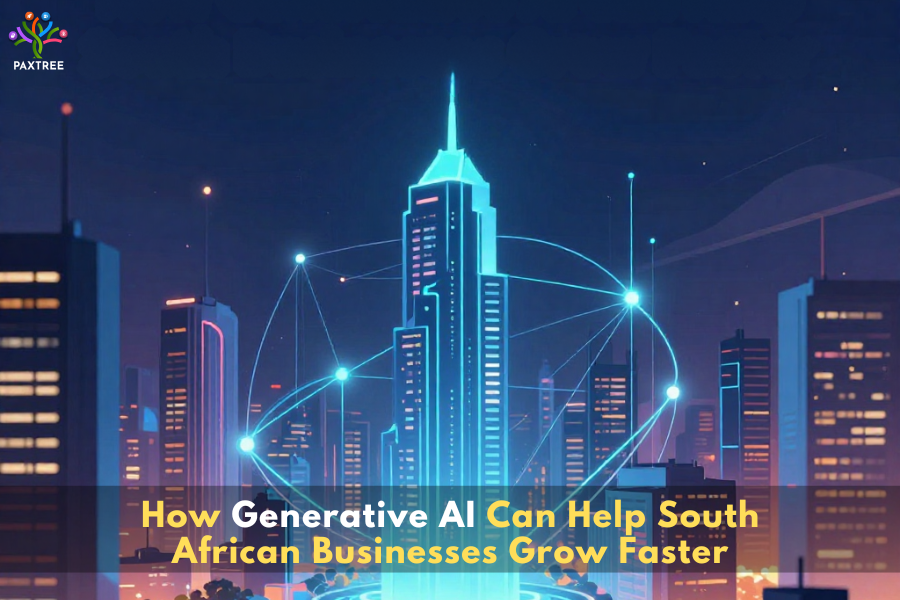
Growing a business in South Africa today comes with real challenges. Power outages, rising costs, and increasing competition from online-first companies are making it harder to stay efficient and profitable.
At the same time, new technologies are changing how businesses operate.
Many South African businesses are now using smarter digital tools to handle repetitive work, improve customer communication, and make better decisions based on data. Tasks that once took hours or days can now be completed much faster, helping teams focus on higher-value work.
This shift is already happening across industries like retail, finance, healthcare, and logistics. Businesses that adopt these tools early are seeing improvements in efficiency, customer experience, and overall growth.
If you want to stay competitive and scale faster, understanding how these technologies fit into your business is becoming essential.
In this guide, we’ll break down how generative AI can support South African businesses, where it delivers the most value, and how you can start using it to achieve real business growth.
Running a business in South Africa in 2026 means navigating a uniquely complex environment – load-shedding pressures on operational continuity, a workforce skills gap in technical disciplines, rand volatility, and intensifying competition from both local and international players entering the market through digital channels.
Yet these same pressures are creating an opening. Companies willing to automate intelligently, serve customers digitally, and make faster decisions with data are pulling ahead. Generative AI sits at the center of that shift.
This is not a distant technology story. South African enterprises across financial services, retail, healthcare, and mining are already deploying AI-driven tools. The question is no longer whether to adopt generative AI, but how quickly and where to focus first.
| ~USD 312M SA GenAI market size (2024) | USD 1.96B Projected SA market by 2030 (CAGR 29.9%) | 92.6% SA businesses that have started their AI journey | 77% SA decision-makers ready to adopt AI |
The term “generative AI” has become a catch-all phrase that often obscures its practical meaning. At its core, generative AI refers to machine learning models that produce original outputs – text, images, code, audio, video, and structured data – based on patterns learned from vast datasets.
For a South African business owner, this translates into six concrete capabilities:
| Content at Scale: Generate product descriptions, marketing copy, social posts, and email campaigns in minutes – localised for South African audiences across English, Zulu, Afrikaans, and other languages. | Intelligent Customer Support: Train AI models on your business knowledge base to answer customer queries instantly, 24 hours a day, reducing call center load and improving satisfaction scores. |
| Data Summarisation: Convert dense spreadsheets, reports, and sales data into concise natural-language summaries that non-technical stakeholders can act on quickly. | Accelerated Software Development: AI coding assistants reduce software development time by up to 50%, enabling faster delivery of apps, APIs, and internal tools without expanding headcount. |
| Document Intelligence: Extract, classify, and analyze contracts, compliance documents, financial statements, and supplier agreements automatically – saving weeks of manual effort per quarter. | Personalised Marketing: Deliver tailored product recommendations, dynamic email content, and customized offers based on individual customer behaviour – at a scale that manual marketing cannot match. |
| Key Insight: Generative AI does not replace your team – it amplifies what each person can produce. A marketing manager who once produced 10 assets a week can produce 60. A developer can ship features in days instead of weeks. That is the real growth lever. |
Every industry has specific processes ripe for AI-driven optimization. The table below outlines where generative AI delivers the most measurable return in a South African context.
| Industry | Primary Use Case | Business Impact |
| Retail & eCommerce | AI-generated product descriptions & personalised recommendations | Higher basket values, reduced content production costs |
| Financial Services | Automated report generation, fraud narrative analysis | Faster compliance reporting, reduced analyst hours |
| Healthcare | Clinical documentation, patient FAQ chatbots | Reduced admin burden, improved patient communication |
| Mining & Resources | Predictive maintenance reports from sensor data | Reduced downtime, lower equipment replacement costs |
| Property & Real Estate | AI-written listings, virtual staging descriptions | Faster listings to market, higher inquiry volume |
| Education | Personalised learning content, tutoring bots | Improved student outcomes at lower delivery cost |
| Logistics & Supply Chain | Route optimisation summaries, demand forecasting | Reduced fuel spend, fewer stockouts |
| Legal & Professional | Contract drafting, clause summarisation | Reduced junior hours, faster client turnaround |
South Africa’s retail sector has faced significant margin pressure over the past three years. A mid-sized apparel brand that partners with an AI development company in South Africa can build a solution that auto-generates product copy for hundreds of new SKUs weekly, translates that content into Zulu and Afrikaans, and personalizes email campaigns based on individual purchase history. The result is a meaningful reduction in content production costs and a measurable uptick in email click-through rates – without adding a single additional full-time employee.
South African banks and insurers operate under strict FSCA regulatory requirements that demand extensive documentation. Generative AI models trained on internal compliance frameworks can draft regulatory submissions, generate client-facing disclosure documents, and summarize audit findings automatically. Compliance officers shift from producing documents to reviewing them – a far better use of their expertise.
AI chatbots represent one of the fastest-growing deployment categories among South African SMEs. An AI chatbot for South African businesses can handle front-line customer queries in English, Afrikaans, and increasingly Zulu and Xhosa – 24 hours a day, 365 days a year. For a mid-sized retailer or service business, this can eliminate 40–60% of inbound support volume handled by human agents, directly reducing operational costs while improving response times.
Adopting generative AI in South Africa is not without friction. Acknowledging these challenges upfront is what separates businesses that successfully integrate AI from those that waste budget on pilots that never scale.
| Challenge | Solution |
| Unreliable electricity supply disrupts AI workloads and cloud connectivity. | Deploy cloud-first architectures with automatic failover and asynchronous processing queues that resume when connectivity restores. |
| Shortage of local AI and machine learning talent raises project costs. | Partner with a specialist AI development company in South Africa that maintains an in-house team, rather than hiring independently into a competitive talent market. |
| Data quality and governance concerns limit what AI models can be trained on. | Begin with a data audit and clean data pipeline before model development, treating data hygiene as a business asset rather than a technical afterthought. |
| Uncertainty around POPIA compliance when using customer data in AI systems. | Implement privacy-by-design principles and work with AI partners experienced in POPIA requirements, including data anonymization before model training. |
The most common mistake organizations make is waiting for the “perfect” AI strategy before taking any action. A measured, phased approach consistently outperforms both premature large-scale deployment and indefinite inaction.
1. Identify Your Highest-Cost Manual Processes: Look for tasks that are repetitive, text-heavy, or data-intensive – customer support responses, internal report writing, and document classification. These are your first AI opportunities.
2. Audit Your Data Readiness: AI is only as good as the data behind it. Assess what structured and unstructured data you hold, where it lives, and how clean it is. This determines what is buildable in the short term.
3. Choose One Focused Pilot: Rather than attempting a broad digital transformation, commit to one AI use case with a defined scope, timeline, and success metric. A 60-day pilot beats a 12-month strategy document that never ships.
4. Partner with a Specialist AI Development Company in South Africa: Building AI capability in-house from scratch is expensive and slow in the current talent environment. A specialist partner brings pre-built frameworks, relevant experience, and the ability to scale your team without permanent headcount risk. Working with a trusted AI development company in South Africa is the fastest route from concept to production.
5. Measure, Iterate, and Scale: Establish baseline metrics before launch -time spent on the task, error rates, and cost per output. After deployment, measure the same variables. Use this data to make the internal business case for scaling AI across additional functions.
6. Build Internal AI Literacy: The businesses that get the most from AI are the ones where employees understand how to work alongside it. Invest in short training sessions for relevant teams -not technical courses, but practical “how to use this tool well” sessions.
| The Paxtree Approach: We work with South African businesses at every stage of this journey – from data strategy and AI/ML development to full solution deployment and ongoing optimization. Our team understands both the technical requirements and the local business context that makes the difference between a proof-of-concept and a production system that actually drives growth. |
In 2026, the way South Africans find businesses online is shifting fundamentally. Google’s AI Overviews now surface direct answers at the top of search results – and those answers are pulled from content that is structured, authoritative, and schema-marked. This shift is called Generative Engine Optimization (GEO), and it is rapidly becoming as important as traditional SEO for South African businesses.
What does GEO mean in practice? If your business publishes content that clearly answers the questions your customers are asking – with structured data, named authorship, and properly cited sources – you are far more likely to appear in AI-generated summaries. These summaries now capture 30–50% of clicks on many commercial queries, meaning businesses that ignore GEO are effectively invisible to a growing share of their target audience.
For South African businesses specifically, GEO creates an early-mover advantage. Adoption of structured content and schema markup remains low among local competitors. Businesses that invest now in content optimized for AI-generated answers – not just traditional blue links – are building a search moat that will be difficult to close.
Paxtree has helped businesses across South Africa move from AI curiosity to AI results. Let’s scope your first project together – no obligation, no jargon.
Is generative AI suitable for small and medium businesses in South Africa?
Yes. Many generative AI tools are available as cloud-based services with pay-as-you-go pricing, making them accessible for SMEs without significant upfront infrastructure investment. The most effective entry points for smaller businesses are AI chatbots for South African businesses, AI-assisted content creation, and automated email marketing. According to Zoho’s 2025 Business Trends Report, 92.6% of South African businesses have already begun their AI journey in some form – the tools are accessible at every budget level.
How does POPIA affect the use of AI on customer data?
POPIA (the Protection of Personal Information Act) requires that personal data be collected and processed lawfully, with the data subject’s knowledge and consent. When building AI systems that use customer data, businesses must ensure data is anonymized or used under explicit consent, that third-party AI vendors meet POPIA’s operator requirements, and that data subjects can request access to or deletion of their information. Working with an experienced AI development company in South Africa ensures these requirements are built into the solution architecture from the outset.
What AI tools are available for South African businesses?
South African businesses have access to the full suite of global AI tools – including large language model APIs (OpenAI, Anthropic, and Google), workflow automation platforms, and purpose-built industry solutions. The distinction is in how these tools are implemented and localized. Paxtree’s team specializes in building and integrating AI tools for South African businesses, accounting for local language requirements, POPIA compliance, and load-shedding-resilient infrastructure.
What is the typical cost of implementing a generative AI solution?
Costs vary significantly based on scope. A focused chatbot or content automation tool can be built for between R80,000 and R250,000. More complex machine learning systems involving custom model training, integration with legacy systems, and data engineering can range from R500,000 to several million rand. The ROI timeline on simpler projects is typically 6 to 12 months. These ranges are based on Paxtree’s project experience as an AI development company in South Africa.
Can AI handle South African languages like Zulu, Xhosa, and Afrikaans?
Multilingual AI capabilities have improved substantially. Modern large language models handle Afrikaans well. Zulu, Xhosa, Sotho, and other South African languages are supported at varying quality levels, and fine-tuning on local language datasets can significantly improve accuracy for specific business contexts.
How long does it take to deploy an AI solution with a development partner?
A scoped AI project with a defined use case typically takes 8 to 16 weeks from initial requirements through to production deployment. This includes data preparation, model development or integration, testing, and staff training. More complex enterprise integrations take longer depending on existing infrastructure.
What is AI implementation for South African businesses?
AI implementation refers to the end-to-end process of identifying the right use case, preparing your data, building or integrating the AI model, testing it against real business scenarios, deploying it into your production environment, and training your team to use it effectively. AI implementation in South Africa follows the same global best practices, with the added requirements of POPIA compliance, local language support, and infrastructure resilience for load-shedding environments.