Home > Blog
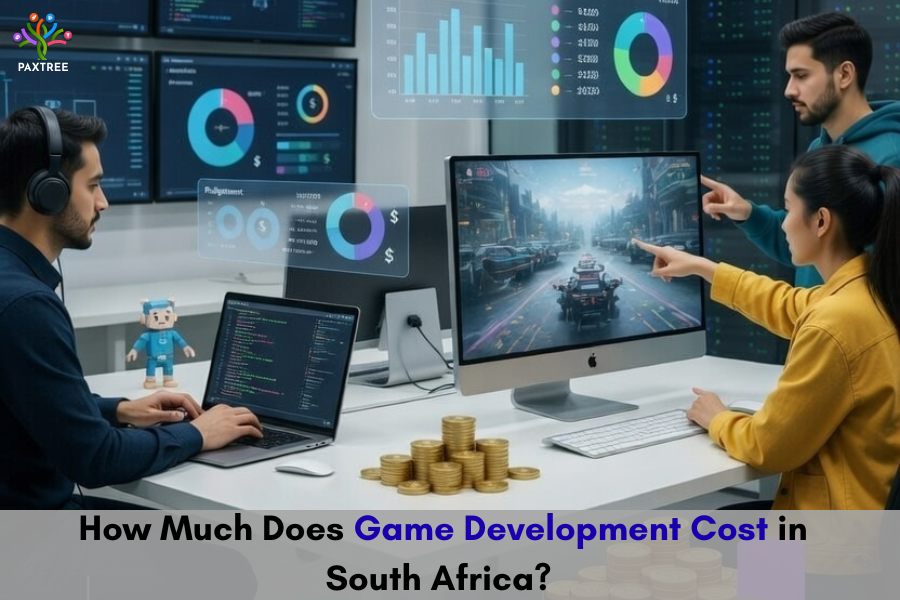
If you are planning a game project, understanding game development cost in South Africa is the first step to budgeting accurately.
It’s the right question – and it deserves a straight answer, not a vague “it depends.”
This guide gives you exactly that. We break down real 2026 game development costs in (ZAR) – by game type, platform, team size, and complexity. Whether you’re a startup founder exploring your first mobile game, a corporate brand considering a gamified training platform, or an entrepreneur with an AR/VR concept, this guide will help you budget accurately and avoid costly surprises.
Here’s the honest short answer before we go deep:
| Game Type | Cost Range (ZAR) | Timeline |
|---|---|---|
| Simple 2D Casual Mobile Game | R90,000 – R370,000 | 2 – 4 months |
| Mid-Core Mobile Game | R370,000 – R1,100,000 | 4 – 8 months |
| Multiplayer Mobile Game | R1,100,000 – R4,600,000 | 8 – 14 months |
| AR / VR Game or Experience | R925,000 – R3,700,000 | 6 – 12 months |
| Gamified Training Platform | R280,000 – R925,000 | 3 – 7 months |
| PC / Console Game | R1,850,000 – R9,250,000+ | 12 – 24+ months |
These are real-world estimates for South African professional development studios in 2026. Now let’s break down exactly what drives each number.
This covers games like endless runners, simple puzzle games, clicker games, and basic arcade titles. Think Flappy Bird or 2048-style mechanics. The budget primarily goes into UI/UX design, core gameplay coding, basic animations, and app store submission for iOS and Android.
What’s included at this tier: single-player mechanics, 2D art assets, basic sound design, leaderboards, ad monetization integration (AdMob), and Play Store / App Store submission.
What pushes costs higher: custom art style, multiple game modes, social sharing features, or in-app purchase (IAP) systems.
Mid-core games feature richer mechanics, progression systems, meta-layers (e.g., base building between levels), social leaderboards, and more sophisticated art. Examples include strategy games, RPGs, or tower defence titles. This is the most popular category for South African businesses commissioning branded or commercial games.
What’s included: complex level design, meta-progression systems, push notifications, analytics integration, basic cloud save, and cross-platform build (iOS + Android).
Multiplayer games are the most technically complex mobile products you can build. Real-time networking, matchmaking infrastructure, anti-cheat systems, server management, and backend scalability all add significant cost and time. This tier is suited for businesses with serious commercial ambitions and an established monetisation model.
Key cost driver: backend server infrastructure alone can cost R70,000 – R925,000 per month in ongoing cloud fees depending on player volumes.
Augmented Reality (AR) and Virtual Reality (VR) development demands specialist skills in 3D modelling, spatial UI/UX design, real-world environment mapping, and hardware-specific optimisation (Meta Quest, Apple Vision Pro, or mobile AR via ARKit/ARCore). South African brands increasingly use AR/VR for training simulations, retail experiences, and marketing activations.
Corporate gamification – applying game mechanics (points, badges, leaderboards, challenges) to training, onboarding, or internal tools – is one of the fastest-growing categories in South Africa. These platforms combine game development with LMS (Learning Management System) integration and typically require POPIA-compliant data handling.
PC and console titles represent the highest investment tier. Longer production cycles, larger art teams, platform certification requirements (Sony, Microsoft, Nintendo), and post-launch LiveOps support all contribute to costs. Most South African businesses commissioning games in this category are doing so for serious commercial publishing or brand IP creation.
Two game projects with the same brief can have wildly different final costs. Here are the seven variables that matter most:
The single biggest cost driver. A game with one core mechanic costs a fraction of one with branching storylines, crafting systems, real-time multiplayer, and seasonal content. Every feature adds development hours – be ruthless about prioritising for your MVP.
Building for a single platform (Android-first is the right call for South Africa, where Android holds over 70% market share) costs significantly less than a simultaneous iOS + Android + PC launch. Cross-platform frameworks like Unity and Flutter reduce costs but add some performance trade-offs on high-end titles.
Art is typically 30–40% of a game’s total development budget. A clean 2D vector art style is far more cost-effective than stylised 3D, which in turn costs less than photorealistic rendering. In 2026, AI-assisted art tools are reducing early-stage art production costs by up to 40% at professional studios – ask your development partner if they’re leveraging this.
Any feature requiring a server – cloud saves, leaderboards, multiplayer, real-time chat, live events – adds backend development cost. This includes ongoing cloud hosting fees that continue after launch. Plan for this in your total budget, not just the development phase.
South African development rates are competitive globally – typically lower than Western Europe or North America, but higher than offshore hubs in India or Eastern Europe. Working with a local South African studio gives you time-zone alignment, clear communication, and no currency risk – advantages that frequently offset slightly higher hourly rates.
Compressing a 6-month project into 3 months requires scaling the team – which increases cost non-linearly. Rushed development also produces more bugs, which means more expensive QA cycles. Build in realistic timelines from the start.
Industry experts consistently recommend budgeting 30-50% of your initial development cost for the first year of post-launch support. This covers bug fixes, OS updates, new content, performance optimisation, and – for multiplayer games – server management. Many South African businesses under-budget this phase and are caught off-guard.
Understanding what each team member costs helps you evaluate studio quotes accurately and know what you’re paying for.
| Role | Annual Salary (ZAR) | Approx. Hourly Rate |
|---|---|---|
| Junior Unity Developer | R314,000 – R400,000 | R280 – R360/hr |
| Mid-Level Unity / Unreal Developer | R480,000 – R700,000 | R390 – R560/hr |
| Senior Game Developer | R815,000 – R1,241,000 | R477 – R720/hr |
| 2D / 3D Game Artist | R280,000 – R560,000 | R250 – R450/hr |
| UI/UX Game Designer | R320,000 – R620,000 | R280 – R500/hr |
| QA / Games Tester | R200,000 – R380,000 | R180 – R300/hr |
| Project Manager | R420,000 – R750,000 | R340 – R600/hr |
| AR / VR Specialist | R700,000 – R1,400,000 | R560 – R1,120/hr |
When you engage a game development company rather than hiring individual contractors, you get access to this entire team under one fixed project cost – with no recruitment fees, employment tax liability, or management overhead on your side.
The quoted development cost is rarely the total cost. Here are the expenses that catch businesses off-guard:
Google Play charges a once-off R380 developer registration fee. Apple’s App Store charges approximately R200/month (USD $99/year). Factor these in before launch.
Any game with a backend – leaderboards, cloud saves, or multiplayer – requires ongoing server hosting. Budget R1,500 – R18,500/month depending on scale, using services like AWS, Firebase, or Azure.
Analytics (GameAnalytics, Firebase), ad networks (AdMob, ironSource), payment SDKs, and in-game chat tools (Photon, Mirror Networking) all come with licensing costs. A typical mid-core game uses 4–8 third-party SDKs.
Every major Android or iOS OS update can break existing features. Budget for at least 2–3 maintenance releases per year post-launch. Skipping this leads to negative reviews and declining installs.
A game nobody knows about earns nothing. South African game studios recommend allocating at least 20–30% of your development budget to user acquisition in the first 3 months post-launch – especially for commercial titles with IAP or subscription monetisation.
| Phase | Duration | % of Total Budget | What Happens |
|---|---|---|---|
| Discovery & GDD | 2 – 4 weeks | 5 – 10% | Game design document, tech stack, scope definition |
| UI/UX & Prototype | 3 – 6 weeks | 10 – 15% | Wireframes, art direction, playable prototype |
| Core Development | 2 – 10 months | 50 – 60% | Gameplay, art, audio, backend, integrations |
| QA & Testing | 3 – 6 weeks | 10 – 15% | Bug fixes, performance testing, device testing |
| Launch & Submission | 1 – 2 weeks | 3 – 5% | App store submission, go-live support |
| Post-Launch Support | Ongoing | 30 – 50% of dev cost / yr | Updates, bug fixes, new content, server management |
Smart scope decisions – not cutting corners – are how successful South African game projects stay on budget.
Launch with your core mechanic, one game mode, and essential features. Validate with real players before investing in additional content, modes, or platforms. The most successful mobile games – including many multi-million-Rand titles – started as focused MVPs.
South Africa’s mobile market is over 70% Android. Launching Android-first cuts your initial development cost by 25–35% compared to a simultaneous iOS build. Add iOS in v2.0 once your game is proven.
Custom game engines are for AAA studios with multi-billion-Rand budgets. Unity and Unreal Engine give you professional-grade tools, a massive asset library, cross-platform export, and a global developer community that dramatically reduces build time and cost.
In 2026, professional studios are using AI tools to reduce background art, texture, and NPC dialogue production costs by up to 40%. When evaluating studios, ask whether they use AI-assisted production pipelines – it directly impacts your budget.
Retrofitting in-app purchases or ad monetisation onto a finished game is significantly more expensive than designing with monetisation in mind from the start. Your development partner should be discussing your monetisation model in the first discovery session – not after the game is built.
At Paxtree, we’ve delivered game development projects across mobile, AR/VR, and gamification platforms for South African businesses, startups, and brands. Here’s what makes us different:
Every project is built by our dedicated in-house team of Unity developers, 3D artists, UI/UX designers, QA engineers, and project managers. You get one accountable partner – not a patchwork of subcontractors.
We provide detailed project scopes and fixed-price quotes upfront. No hidden fees, no scope creep surprises. You know exactly what you’re getting and what it costs before we write a single line of code.
We build for the South African market – Android-first development, local payment integration, POPIA-compliant data handling, and an understanding of how South African players interact with mobile games. We’re in your time zone, speak your language, and understand your market.
Every Paxtree project includes a structured post-launch support plan – OS compatibility updates, bug fixes, performance monitoring, and optional LiveOps packages for games with ongoing content needs.
A simple 2D mobile game costs between R90,000 and R370,000. A mid-core game with progression systems and social features typically costs R370,000 to R1,100,000. Multiplayer and AR/VR titles can range from R1,100,000 to R4,600,000+. The exact cost depends on complexity, art style, platform, and team seniority.
A simple mobile game takes 2–4 months. A mid-core game typically takes 4–8 months. Multiplayer, AR/VR, and PC titles can take 8–24 months. Rushing timelines increases costs – realistic planning from the start saves budget in the long run.
Unity is the most widely used engine for mobile and indie game development in South Africa, followed by Unreal Engine for more graphically intensive projects. Both are cross-platform and cost-effective. Custom engines are rarely justified outside of large AAA budgets.
Yes – this is one of the most commonly missed budget items. Plan for 30–50% of your development cost per year in post-launch support, covering OS updates, bug fixes, new content, and server management. Skipping post-launch investment leads to declining ratings and user drop-off.
Yes. Paxtree builds commercial mobile games, branded gamification platforms, AR/VR training simulations, and educational games for South African businesses and corporates. Contact our team for a free scoping session and cost estimate tailored to your specific requirements.
Conclusion
Game development in South Africa in 2026 has never been more accessible – or more competitive. Costs range from R90,000 for a simple mobile title to R9,250,000+ for a full-scale multiplayer or console game. The right budget depends entirely on your game type, target audience, platform strategy, and post-launch ambitions.
The most important thing you can do right now is get a proper scoping conversation with an experienced development partner – one who will give you honest numbers, challenge your assumptions, and help you prioritise the features that actually matter for launch.
That’s exactly what Paxtree does.
Ready to get a real cost estimate for your game?
Talk to Paxtree’s game development team – we’ll scope your project and give you a detailed, no-obligation quote within 24 hours.